PEVA and aluminum-foil-style materials are two common lining directions for insulated cooler bags, lunch bags and thermal carriers. They should not be selected from colour or material name alone. The liner interacts with insulation, seams, closure, compartment shape, cleaning method and intended contents.
Direct answer: PEVA is often considered when a smooth, flexible and wipeable liner direction is wanted, while an aluminum-foil-style laminate is often considered for a visibly reflective thermal-bag interior. Neither material is automatically more insulating, leakproof, durable or food-contact suitable. Specify the exact multilayer construction and compare finished samples under the same cleaning, seam, leak and thermal test conditions.
PEVA vs aluminum foil cooler bag lining at a glance
| Decision point | PEVA lining direction | Aluminum-foil-style lining direction | What the buyer should control |
|---|---|---|---|
| Visual direction | Can be clear, coloured, white, silver or otherwise finished | Commonly selected for a metallic or reflective appearance | Physical colour, gloss, texture and approved sample |
| Material identity | PEVA film or a PEVA-containing laminate may differ by supplier | May be foil, metallized film or another foil-style laminate | Layer construction, supplier code, thickness and backing |
| Hand and folding | Depends on gauge, lamination, backing and temperature | Depends on foil/film layer, reinforcement, backing and embossing | Bend, crease, corner and low-temperature sample review |
| Cleaning | Smooth surfaces may support wipe-clean designs | Surface and embossing can change soil visibility and wiping | Soil type, cleaner, access, seam and care protocol |
| Joining | Can be stitched, welded or combined, subject to exact material compatibility | Often stitched or laminated; exact joining limits depend on construction | Seam method, needle holes, fold path and proof trial |
| Thermal role | Inner surface within a complete insulation system | Reflective-facing layer within a complete insulation system | Finished-bag comparison under one controlled protocol |
| Claims | Name alone proves no leak, food-contact or thermal result | Reflective appearance proves no holding time or compliance | Exact-product documents and agreed verification |
These are development directions, not universal property guarantees. Supplier formulation, laminate structure and bag construction can create more difference than the generic label.
First confirm what the material name actually means
“PEVA” and “aluminum foil” are often used as shorthand in product discussions. A controlled specification needs more detail.
For a PEVA direction, ask for:
- film or laminate construction and named functional layers;
- supplier and material code;
- colour, texture and surface finish;
- nominal thickness and tolerance;
- backing, scrim, foam or textile carrier;
- joining and sealing compatibility;
- operating, folding and cleaning limitations;
- documentation applicable to the exact supplied grade.
For an aluminum-foil-style direction, clarify:
- whether the structure contains foil, a metallized film or another reflective layer;
- which face is exposed inside the bag;
- backing, reinforcement, bubble, foam or textile layers;
- embossing, coating and protective surface;
- total thickness and thickness of relevant layers;
- fold, puncture, abrasion and joining direction;
- documents and tests applicable to the complete laminate.
Do not convert a marketing description into a composition claim. Record the supplier construction in the bill of materials and link it to the approved physical sample.
PEVA lining direction
PEVA is a polymer material family, not one universal cooler-bag sheet. A product developer may consider it for a smooth interior, colour options, flexibility and wipe access. Actual behaviour depends on formulation, thickness, backing, joining and the geometry of the liner.
Review a physical sample for:
- hand, drape and recovery after folding;
- appearance around corners and seam allowances;
- pinhole or needle-hole behaviour;
- compatibility with the planned welding or sewing method;
- abrasion against containers, ice packs and interior dividers;
- response to the intended cleaner and wiping method;
- odour, surface change or stiffness under agreed conditions;
- lot colour and thickness controls.
A thicker PEVA direction is not automatically more flexible, durable, cleanable or thermally effective. Thickness is one controlled field in a larger system.
Aluminum-foil-style lining direction
An aluminum-foil-style liner can create the familiar silver, reflective appearance associated with many thermal bags. The visible layer may be part of a laminate rather than a standalone sheet.
Review:
- exact reflective-layer identity and exposed surface;
- crease whitening, permanent fold marks and corner behaviour;
- puncture and abrasion at container edges;
- delamination or surface separation after flexing;
- stitch holes, seam allowances and binding interaction;
- print, coating or embossing where present;
- cleaning appearance and residue visibility;
- sample behaviour at the intended service temperature.
A reflective surface can influence radiative heat transfer under suitable conditions, but it does not replace insulation thickness, closure control or finished-product testing.
A silver photo cannot identify the lining
The two first-party Benshine references below both look silver, yet their source product records identify different lining directions.
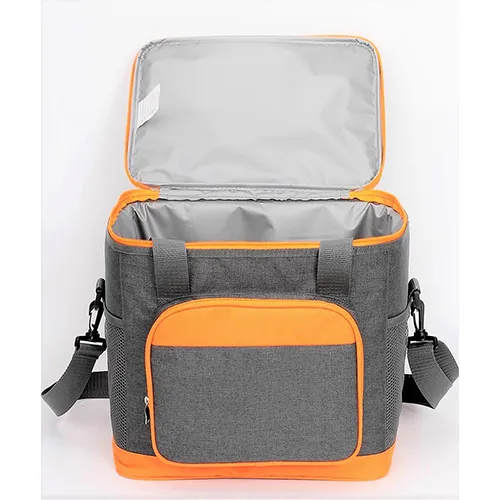
The published BCB03 record identifies a PEVA lining. Its silver appearance is not proof of aluminum composition. See the BCB03 product reference.
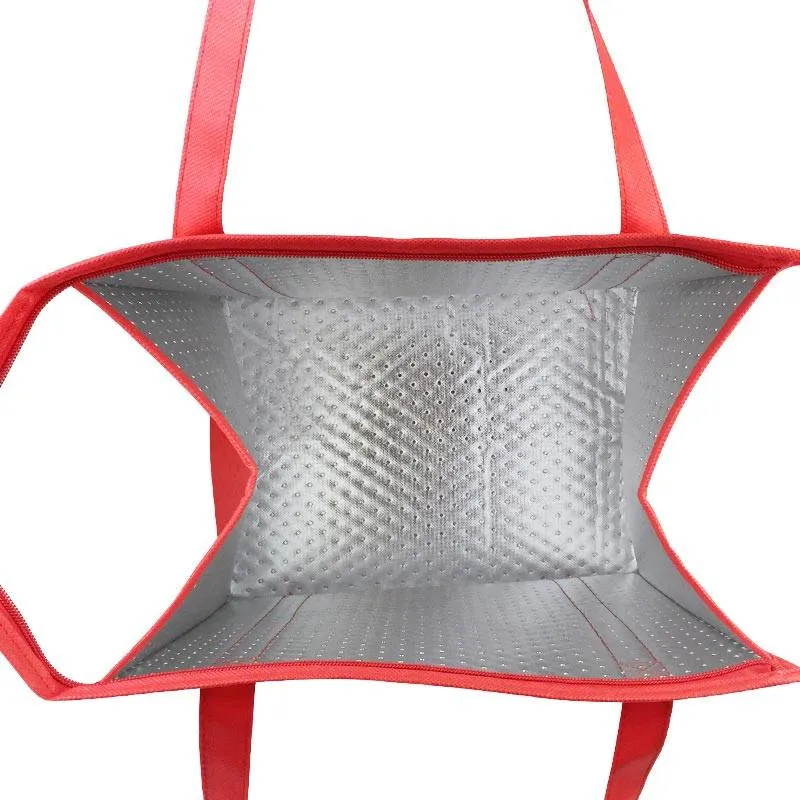
The published AF01 record identifies aluminum foil in its material direction. A buyer still needs the exact laminate specification and project evidence. See the AF01 product reference.
Use appearance to approve the visual result, not to infer composition, food-contact status, leak resistance or thermal duration.
Cooler bag insulation is a complete system
The liner is the innermost visible layer, but temperature change is affected by the whole assembly:
- Exterior shell: surface, weave, coating, colour and construction affect exposure and handling.
- Insulation layer: material, thickness, density, continuity and compression influence conductive heat flow.
- Lining: surface, laminate, seams and contact with the contents affect cleaning and internal construction.
- Thermal bridges: stitched seams, compressed corners and hardware paths can interrupt the insulation layer.
- Opening and closure: lid fit, zipper path, hook-and-loop areas and gaps influence air exchange.
- Compartment geometry: surface-area-to-volume relationship and unused air space affect the test result.
- Use conditions: ambient temperature, solar exposure, contents, coolant, fill level and opening frequency can dominate performance.
This is why a material swatch cannot establish how long a finished cooler bag will maintain a target temperature.
Specify the insulation layer separately
Do not use the lining name as shorthand for the entire thermal package. Control the insulation direction with fields such as:
- material family and supplier code;
- nominal thickness and tolerance;
- density or other relevant physical direction;
- layer coverage across lid, walls, base and dividers;
- joints, gaps and overlap direction;
- compression at seams, piping and binding;
- interaction with support boards and shape layers;
- applicable material or finished-assembly tests.
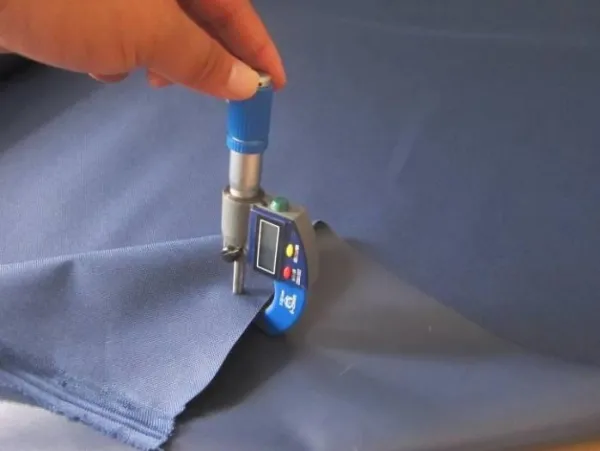
A thickness reading is useful only when the material, location, tool, method, conditioning and tolerance are defined. It does not by itself predict finished-bag thermal performance.
Liner pattern, corners and seam construction
The same lining material can behave differently in two liner constructions.
Stitched liner
A stitched liner can follow familiar cut-and-sew production. Review needle holes, seam allowance, binding, exposed edges, corner bulk and whether liquid can reach insulation through the seam path.
Welded or sealed liner
A compatible film construction may support welded or sealed joins, but compatibility depends on the exact material, equipment, geometry and process. Approve corner construction and representative production trials. A welded seam name is not automatic proof of a leakproof finished bag.
Drop-in or separate liner
A separate liner direction may improve access for cleaning or replacement in some designs. It can also create fit, folding, air-gap, attachment or movement questions. Define whether it is removable and how the user should clean and reinstall it.
Base and corner geometry
Sharp corners can concentrate folds and make wiping difficult. A shaped base, larger corner radius, fewer seam intersections or removable insert may improve the intended workflow, subject to the approved construction.
Use the pattern and gusset guide to control liner dimensions, mating edges and seam allowances.
Leak resistance is a construction claim
A lining sheet may resist liquid penetration while the finished liner still contains stitch holes, zipper openings, drain points or interrupted seams. Define the required claim precisely:
- resistance to incidental condensation;
- containment of a specified small spill;
- no visible leakage under a defined fill-and-hold method;
- resistance in one orientation or during movement;
- exclusion of zipper and opening areas;
- allowable dampness, seepage or mass change;
- test duration, liquid temperature and sample condition.
Avoid using “waterproof” or “leakproof” when the project only requires an easily wiped lining. If a claim matters, write the finished-bag test method and acceptance criterion before sampling.
Cleaning, condensation and hygiene planning
Start with what will be carried and how the user is expected to clean the compartment.
Questions include:
- Are contents sealed packages, drink containers, ice packs or unpackaged items?
- Is the likely soil water, condensation, food residue, oil or another substance?
- Can the user see and reach every base corner and seam?
- Is the liner fixed, removable or reversible?
- Which cleaner, concentration, temperature and contact time are intended?
- Should the bag be wiped, rinsed or fully washed?
- Where does residual liquid collect and how does the bag dry?
- Can foam, board or insulation absorb liquid through seam paths?
- Do colours, prints, adhesives or coatings tolerate the care method?
- What care wording can be supported by the approved sample and tests?
Smooth appearance does not prove hygienic performance. Cleaning instructions should match the exact finished construction.
Food-contact and intended-content evidence
Packaged-food transport and direct contact with unpackaged food are different evidence questions. Define:
- whether food touches the liner directly;
- food type, including aqueous, acidic, fatty or dry direction where relevant;
- contact time and temperature;
- repeated-use and cleaning conditions;
- target market and applicable legal requirements;
- exact material grade, colour, laminate, adhesive and printed surface;
- supplier declaration and testing needed for that use;
- change control for formulation or source.
A report for one layer, grade or sample should not be extended to a different laminate or finished bag without confirming applicability. Review Benshine’s quality and test-document scope before using any record in a product claim.
Mechanical durability and use risks
Cooler bag liners can encounter folding, creasing, abrasion, puncture, seam stress and cleaner exposure. Map the risks to the intended product:
| Use condition | What to examine on a representative sample |
|---|---|
| Repeated lid opening | Fold line, crease, separation, zipper-area movement |
| Rigid containers | Point contact, corner abrasion and puncture risk |
| Removable ice packs | Edge wear, condensation and repeated insertion |
| Heavy fill | Base support, seam path and liner-to-shell movement |
| Low-temperature use | Flexibility, cracking or stiffening under agreed conditions |
| Cleaning cycle | Surface change, colour transfer, delamination, odour and drying |
| Storage while folded | Permanent creases, blocking, print transfer and shape recovery |
There is no useful universal “most durable” answer without a material construction, bag design and controlled method.
Build a comparable thermal test
For development, compare PEVA and foil-style samples using the same finished-bag geometry and protocol wherever practical. Record:
- sample identity, BOM revision and conditioning;
- ambient temperature, humidity and exposure direction;
- starting temperature of bag, contents and coolant;
- content or simulant type, mass and arrangement;
- coolant type, quantity, temperature and placement;
- compartment fill level and unused volume;
- probe type, number and fixed locations;
- opening schedule and closure method;
- bag orientation and handling during the test;
- reading interval, total duration and acceptance rule;
- comparison baseline and treatment of anomalous readings.
Do not compare one liner in a thick, tightly closed bag with another liner in a thinner or differently shaped sample and attribute the result only to the lining.
Approve physical samples, not generic names
A controlled sample sequence can include:
- Material swatches: compare surface, colour, hand, construction and documentation.
- Joined panels: review sewing or welding, folds, corners and cleaning response.
- Liner prototype: check fit, access, base geometry, movement and seam routes.
- Finished cooler bag: review the complete shell, insulation, liner and closure system.
- Use-based tests: apply agreed thermal, leak, cleaning and durability protocols.
- Pre-production reference: freeze the BOM, supplier codes, pattern, sample and acceptance criteria.
Record every approved change. A substitution in the liner, foam, adhesive, backing or joining process can affect earlier conclusions.
Quality-control points for production
Depending on the project, incoming, in-line and finished-product controls can include:
- material and supplier-code identity;
- colour, gloss, embossing and surface condition;
- total or layer thickness under an agreed method;
- visible damage, puncture, crease or delamination;
- pattern direction and cut-part identity;
- seam or weld continuity and corner construction;
- liner fit, wrinkles and attachment to the outer bag;
- zipper, lid and closure alignment;
- defined leak or functional sample check;
- cleaning, thermal or other project-specific verification;
- packaging that avoids unwanted folding or compression.
See the custom bag quality-control guide for sampling, defect classification and release planning.
RFQ checklist for a cooler bag lining
Send the manufacturer:
- intended bag type and use scenario;
- packaged or direct-contact contents;
- target market and evidence requirements;
- liner direction and exact preferred construction, if known;
- colour, finish, texture, hand and visual reference;
- insulation material, thickness, coverage and support layers;
- compartment dimensions and usable-volume requirements;
- stitched, welded, removable or other liner direction;
- closure, lid and opening geometry;
- expected cleaning and drying method;
- thermal, leak, seam, folding, abrasion or puncture requirements;
- written test protocols and acceptance rules;
- approved sample, BOM and change-control requirements;
- quantity by colour and version;
- packaging and delivery requirements.
MOQ, cost and timing depend on the specified laminate, insulation, construction, tooling, tests, quantity and material availability. Request project-specific confirmation rather than applying a generic number.
Select the liner as part of the complete cooler bag
Benshine can review intended contents, reference products, compartment geometry, liner and insulation directions, cleaning needs, target-market evidence and performance protocols for a custom project. The final material construction and claims should be based on approved physical samples and order-specific evidence.
Send your cooler bag specification or explore custom cooler bag manufacturing and custom lunch bags.
Quick answers
Is PEVA or aluminum foil better for a cooler bag lining?
Neither is universally better. The appropriate direction depends on the exact laminate, intended contents, cleaning method, folding and puncture exposure, seam construction, appearance, evidence requirements and complete insulation system. Compare representative constructions under the same use-based test.
Is the shiny lining the insulation in a cooler bag?
The lining is only one part of the assembly. Thermal behaviour also depends on the shell, foam or other insulation, air gaps, seam paths, lid and closure, compartment geometry, fill level, coolant, ambient conditions and opening frequency. A shiny surface alone does not establish a holding time.
Can a silver lining be identified as aluminum foil by appearance?
No. PEVA and other polymer-based liners can be supplied in silver or laminated constructions, while aluminum-foil-style products may also be multilayer laminates. Confirm the supplier construction, layer identity, code, thickness and applicable evidence instead of classifying the material from a photograph.
Does PEVA make a cooler bag leakproof?
Not by material name alone. Leakage depends on punctures, folds, liner pattern, seam and joining method, zipper or opening, drain details and finished construction. Any leak-resistant or leakproof claim needs a defined test method and an exact approved product.
Are PEVA and aluminum foil linings food safe?
A broad material name or silver appearance does not prove suitability for direct food contact. Define packaged or unpackaged contents, temperature and target market, then obtain evidence for the exact supplied construction and intended contact conditions.
How should a cooler bag construction be tested?
Use a written protocol covering the exact sample, ambient conditions, starting temperatures, contents or simulant, coolant type and mass, fill arrangement, opening schedule, probe locations, duration and acceptance rule. Add cleaning, leak, seam and durability checks when those claims matter.