
International freight planning for a custom bag order begins before the cartons reach a warehouse. Product shape, packaging, carton configuration, handover responsibilities, inspection release, booking data, documents and destination procedures form one connected delivery plan.
Direct answer: Define the complete delivery route, named handover point, responsible parties and required milestones before confirming the order. Approve a production-intent packing method, obtain measured carton data, compare quotations on the same scope and keep production completion separate from carrier departure or final delivery. Freight price, route, space and timing require current confirmation for the specific shipment.
This guide replaces Benshine’s historical 2021 container-shortage article. It does not predict current freight markets. It provides an evergreen framework that a buyer can use with Benshine, its freight forwarder, customs adviser and destination partners.
Build one delivery plan from five connected layers
| Planning layer | Decision to record | Evidence or record |
|---|---|---|
| Product | Finished construction, packed shape and surfaces that need protection | Approved sample, specification and packing trial |
| Packing | Individual pack, units per carton, carton specification and labels | Packing instruction, carton drawing and approval photographs |
| Handover | Named place, selected trade term and transfer responsibilities | Purchase order and written responsibility matrix |
| Transport | Mode, route, booking basis, cargo-ready window and contingency | Comparable forwarder quotations and booking confirmation |
| Import and delivery | Documents, clearance responsibility, appointment and receiving limits | Destination checklist and shipment document set |
The layers should be reviewed together. A change from a foldable tote to a structured insulated bag, for example, can alter carton volume, compression tolerance and handling even when the unit quantity remains unchanged.
Separate every milestone in the delivery timeline
“Delivery date” is too vague for a controlled plan. Record each milestone with an owner and status:
- Product specification released for production.
- Production packing method approved.
- Production completed and internal records closed.
- Buyer inspection or release condition completed, when required.
- Final packed quantity, carton count, dimensions and weight confirmed.
- Cargo accepted at the agreed handover point.
- Carrier booking confirmed.
- Actual departure recorded.
- Arrival at the destination port, airport or terminal recorded.
- Import clearance completed by the responsible party.
- Final delivery appointment and receipt completed.
An estimated factory completion date does not guarantee carrier space, departure, customs clearance or final delivery. Likewise, a quoted transit duration is not a complete door-to-door schedule unless the quotation explicitly includes the other stages.
Define the handover term and named place precisely
A trade term without a named place leaves an important gap. Record the selected term, exact handover location, version referenced by the contract and who arranges each service. Confirm responsibility for:
- export packing and shipment labels;
- movement from the factory to the handover point;
- export formalities and terminal handling;
- main transport booking and charges;
- cargo insurance, if required;
- destination handling, customs clearance, duties and taxes;
- delivery appointments, unloading and proof of receipt.
The commercial contract and qualified logistics advisers should resolve legal, customs and insurance responsibilities. Informal phrases such as “shipping included” or “door price” are not a substitute for a written scope.
Measure the shipment instead of relying on catalogue assumptions
The freight data pack should identify whether every figure is an estimate or a final packed measurement. Include:
- exact product and purchase-order reference;
- finished quantity and any approved overage or shortage rule;
- units per inner pack and per export carton;
- total carton count;
- outer carton length, width and height using one stated unit;
- net weight and gross weight per carton;
- total measured volume and total gross weight;
- pallet dimensions and loaded height when pallets are used;
- cargo description and handling restrictions;
- marks, labels, barcodes and document-pouch position;
- production-complete and cargo-ready windows.
Do not copy an old shipment profile to a revised product without checking the packaging. Different foam, handles, inserts, retail boxes, hardware or folding instructions can change both dimensions and weight.
Design and packaging decisions affect freight
Soft bags may look compressible, but the complete construction determines whether compression is acceptable.
| Product or packing feature | Freight-planning question |
|---|---|
| Foam or structured panels | Will folding or pressure create permanent deformation? |
| Clear windows or coated surfaces | Can contact, heat or pressure cause blocking, marking or haze? |
| Printed or transferred artwork | Does the decoration need tissue, separation or controlled folding? |
| Metal hardware | Can components scratch adjacent surfaces or puncture packaging? |
| Insulated layers | Will compression affect recovery, appearance or approved construction? |
| Long straps and handles | How are they restrained without creating creases or tangles? |
| Retail boxes or inserts | Are the dimensions fixed, and do they protect the approved presentation? |
| Moisture-sensitive packing | What storage, container and destination conditions must be considered? |
Run a packing trial with production-intent materials. Photograph the sequence, record the number of units, close the carton, apply the expected stacking or handling condition and reopen it after a defined period. Approve appearance, shape, decoration, hardware contact and recovery against written criteria.
Specify the export carton and marks
An export-carton instruction should state board or construction requirements where relevant, finished dimensions, closure method, reinforcement, maximum agreed gross weight, unit orientation and any inner protection. Carton strength or stacking claims need an agreed method and acceptance criteria; appearance alone is not evidence.
Shipping marks should be controlled artwork, not free-typed at the packing station. Depending on the project, the approved mark file may include:
- consignee or customer reference;
- purchase order and item code;
- destination or routing mark;
- carton sequence, such as carton 1 of a defined total;
- quantity, net weight, gross weight and dimensions;
- country-of-origin or handling statements when applicable;
- barcode, label placement and scan requirements.
The buyer should confirm destination-market marking and language requirements. Not every project needs every field.
Compare transport modes using the same scope
Mode labels do not determine the best route on their own. Compare the actual cargo and delivery requirement.
| Mode or service | Questions to compare | Avoid assuming |
|---|---|---|
| Courier or parcel | Piece limits, dimensional basis, customs service and remote-area scope | That every bag order qualifies or includes all import charges |
| Air freight | Chargeable basis, airport services, security screening and destination handling | That airport arrival equals final delivery |
| Sea freight | Load type, port pair, origin and destination charges, routing and free-time assumptions | That the lowest ocean line item is the lowest total landed route |
| Consolidated service | Cut-off, consolidation handling, deconsolidation and minimum charges | That different quotations use the same consolidation schedule |
| Multimodal route | Transfer points, document flow, handover risks and accountable carrier | That a quoted duration includes every transfer and border stage |
Ask each provider to quote the same origin, destination, cargo profile, ready window, service scope and responsibility split. Separate estimated and fixed items, and record quotation validity rather than treating a historical rate as current.
Control documents before cargo handover
The exact document set depends on the route, transaction and destination. Build a checklist with the buyer, forwarder and customs adviser. Typical project discussions may include:
- commercial invoice information;
- packing-list information;
- transport document instructions;
- shipper, consignee and notify-party details;
- product description and item references;
- origin information or supporting records when required;
- insurance instructions or certificate when applicable;
- destination-specific declarations, licenses or supporting documents;
- document format, issue timing and approval owner.
Names on orders, invoices, packing lists and transport instructions should be checked for consistency. A last-minute consignee, description or quantity change can affect documents and should follow written change control.
Link inspection release to shipment release
Decide whether cargo may be booked, handed over or departed before the buyer’s required inspection or document review is complete. A practical release record can include:
- purchase order and product revision;
- inspected quantity or sampling basis;
- packing and carton checks;
- approved shipping marks;
- open deviations and written disposition;
- final packed quantity and carton data;
- person authorized to release the cargo;
- date and revision of the release.
Review Benshine’s quality-control framework and the guide to incoming, in-line and pre-shipment bag quality control.
Use a responsibility and risk register
Keep a short live register rather than relying on message history.
| Risk or dependency | Early control | Decision owner |
|---|---|---|
| Packing dimensions change | Production-intent packing trial and final measurement gate | Buyer and manufacturer |
| Cargo misses intended handover | Separate production, inspection and booking milestones | Named project coordinators |
| Document mismatch | Pre-agreed data sheet and document review | Shipper, buyer and appointed advisers |
| Surface or shape damage | Pack-out trial with agreed acceptance criteria | Product and quality teams |
| Route or space change | Current alternatives from the appointed forwarder | Buyer or booking party |
| Customs query | Controlled description and destination advice | Importer and customs adviser |
| Receiving constraint | Appointment, vehicle, pallet and unloading review | Destination warehouse |
Contingency planning does not mean promising that disruption cannot occur. It means deciding who will identify a change, what alternatives may be evaluated, who approves cost or timing consequences and how the product and documents remain controlled.
Benshine’s role in a shipment discussion
Benshine can discuss the bag specification, approved packing method, production records, carton data, factory handover and agreed shipment documents for a defined order. The buyer should identify its booking party, importer responsibilities, destination advisers, required trade term and delivery constraints.
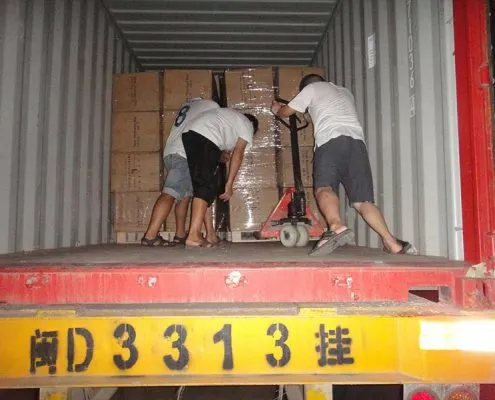
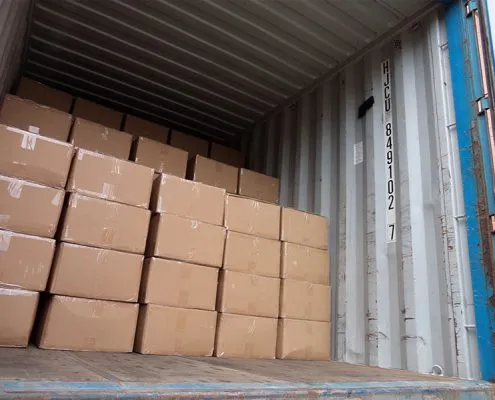
First-party photographs can show that packing and loading activities have occurred at Benshine, but they do not prove current freight capacity, a carrier booking, route availability, customs outcome or delivery date.

Freight-planning checklist for a custom bag RFQ
Send the following known information with the product brief, and mark unknown fields for later confirmation:
- product type, specification revision and intended use;
- order quantity and destination market;
- product dimensions and estimated unit weight;
- individual packaging and retail-presentation requirements;
- carton limits, pallet requirements and receiving constraints;
- required shipping marks, labels and barcodes;
- named origin and destination points;
- preferred handover term and exact named place;
- target cargo-ready window and required delivery milestone;
- party responsible for booking, insurance, export and import tasks;
- required inspection and shipment-release gates;
- document list and approval contacts;
- known handling, storage or surface-protection requirements;
- acceptable alternatives if route, space, packing or timing changes.
Use the same data pack when comparing options. For product and commercial inputs, combine this checklist with the custom bag manufacturing workflow, MOQ and cost-factor guide and contact/RFQ page.
Quick answers
When should freight planning start for a custom bag order?
Start while the product and retail packaging are being specified. Bag structure, packed shape, folding method, individual packaging and carton limits affect the shipment profile, so waiting until production is complete can remove useful options.
What information is needed for a custom bag freight quotation?
Provide origin and destination points, the requested handover term and named place, cargo-ready window, carton count, carton dimensions, gross and net weight, cargo description, declared value, packaging method and any handling or documentation requirements. Mark estimates clearly until production packing data is confirmed.
Does an estimated production completion date guarantee a vessel or flight departure?
No. Production completion, inspection release, cargo handover, carrier acceptance, departure, arrival, customs clearance and final delivery are separate milestones. Each depends on current availability, documents and the responsible parties.
Is sea freight always the cheapest way to ship custom bags?
Not necessarily. Compare the same shipment scope, chargeable basis, origin and destination services, surcharges, handling, clearance responsibilities, transit assumptions and risk. A lower headline freight rate may exclude material costs elsewhere in the route.
Can finished bags be compressed to reduce freight volume?
Only when the approved construction, decoration and packaging can tolerate the defined compression and recovery cycle. Structured panels, foam, windows, molded parts, hardware and printed surfaces may crease, deform or mark, so packing trials should use production-intent samples.
Who is responsible for customs classification and import compliance?
Responsibility depends on the transaction and destination. The importer and its appointed customs or logistics advisers should confirm classification, valuation, origin, duties, taxes, licenses and market requirements. A manufacturer can provide agreed product and shipment data but should not be treated as the sole authority for the importer's obligations.