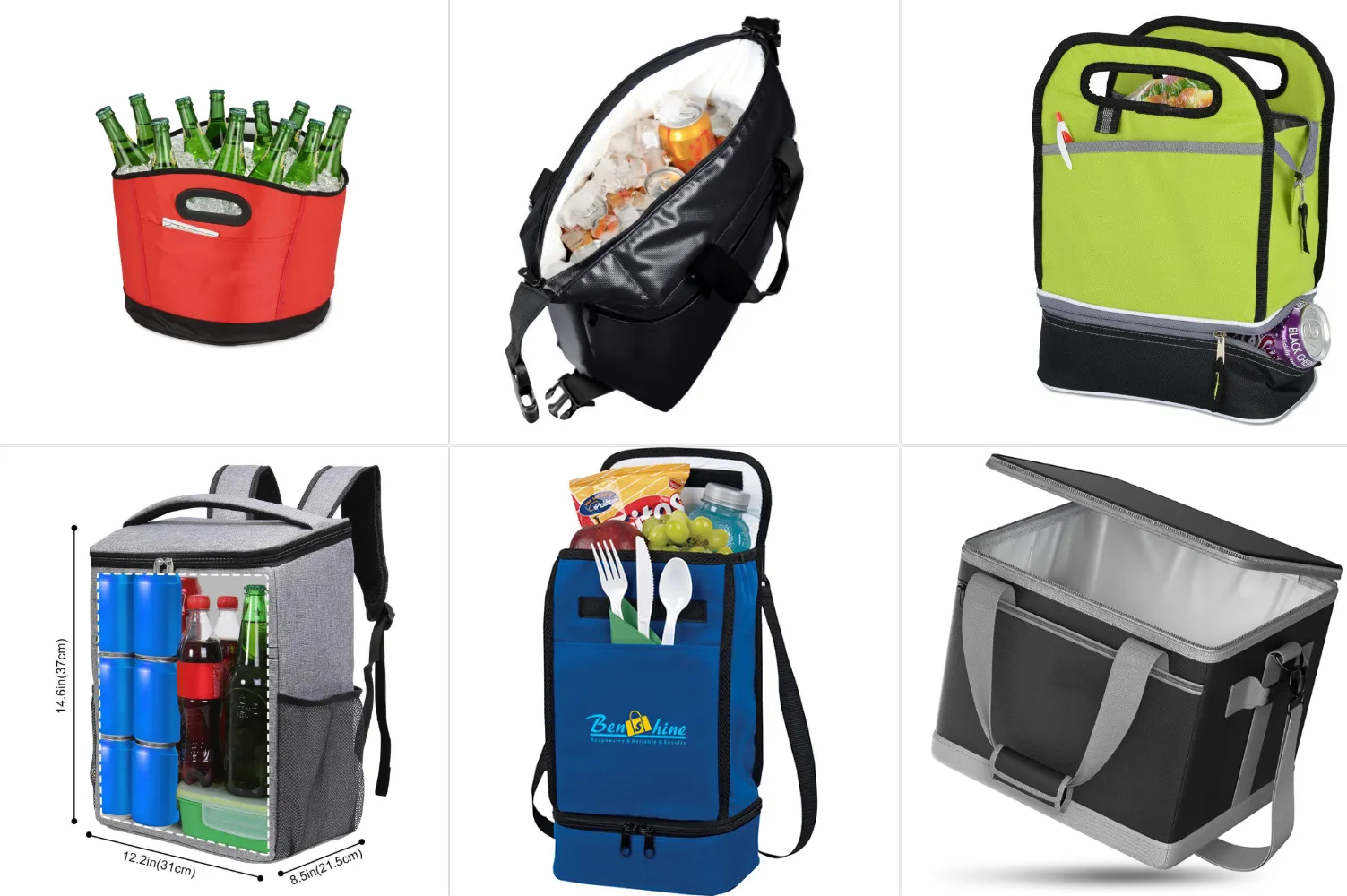
A cooler bag is both a container and a thermal system. Its useful design depends on what goes inside, how it is packed, how far it travels, how often it opens and how it is cleaned. A generic request for “an insulated bag” leaves the most important product decisions unresolved.
Direct answer: Begin a cooler bag design with the actual containers, count, orientation, packed mass, starting condition, journey and opening schedule. Define usable internal dimensions, shell, insulation, liner, seams, closure, support and carrying around that use. “Cooler bag” does not automatically guarantee holding time, leakproofness, food-contact suitability, cleanability, capacity, load performance or hot-and-cold use.
Cooler bag specification at a glance
| Decision | Buyer input | What not to assume |
|---|---|---|
| Contents | Container sizes, count, orientation and packed mass | Capacity from external dimensions or a litre label |
| Journey | Starting condition, ambient exposure, duration and openings | A universal temperature-hold time |
| Format | Lunch, tote, box, backpack or bottle direction | That one shape is best for every workflow |
| Thermal system | Shell, insulation, liner, seams, lid and support | Performance from one layer name or thickness |
| Access | Lid, zipper, roll, flap or other opening | Airtightness or low heat exchange from appearance |
| Leakage | Liquid source, orientation, duration and allowed result | Leakproofness from a silver liner or sewn seam |
| Carrying | Packed load, distance, handles, strap or backpack harness | Safe load or comfort from strap width alone |
| Evidence | Finished sample, written method and acceptance rule | Universal compliance or commercial terms |
This guide focuses on converting a use case into a product brief. For detailed heat-transfer, liner and test-system engineering, use the insulated cooler bag construction guide alongside this page.
Start with contents and the complete journey
List every intended container or item, including dimensions, count, orientation, packaging and mass. Record whether contents are chilled, frozen, warm, ambient or combined with coolant. Explain how the bag moves: hand carry, vehicle, outdoor exposure, workplace storage, retail delivery or another route.
Define the expected duration, ambient conditions, direct sunlight or sheltered use, opening frequency and time open. Note whether users add ice packs, loose ice, hot packs or no thermal aid. These variables influence bag geometry, closure, lining, reinforcement and the test protocol.
Do not begin with an unsupported statement such as “keep cold for eight hours.” Begin with a measurable use scenario and build a sample that can be tested against it.
Create a real packing layout
Draw or photograph the intended packing arrangement. Record container orientation, clearances, coolant position, dividers and unused air space. Tall bottles, meal boxes and cans can require different openings even when their calculated volume is similar.
Check whether users load the bag from the top, side or through a clamshell opening. Include hands and grip space in the access review. A tightly optimized internal layout can become impractical if the container cannot pass the zipper or turn inside the bag.
Approve the layout with real containers or controlled models. If several container sets are required, identify the largest envelope and confirm each arrangement separately.
Separate external dimensions from usable volume
Insulation, lining, seam allowances, piping, corner radius, base support and structure consume internal space. A bag measured outside cannot be assumed to provide the same length, width and height inside. Soft walls also deform under load.
Specify finished external dimensions and usable internal dimensions with named measurement points and bag condition. Record the clear opening separately. If capacity is stated in litres, define the calculation or physical fill method and do not substitute it for a container-fit test.
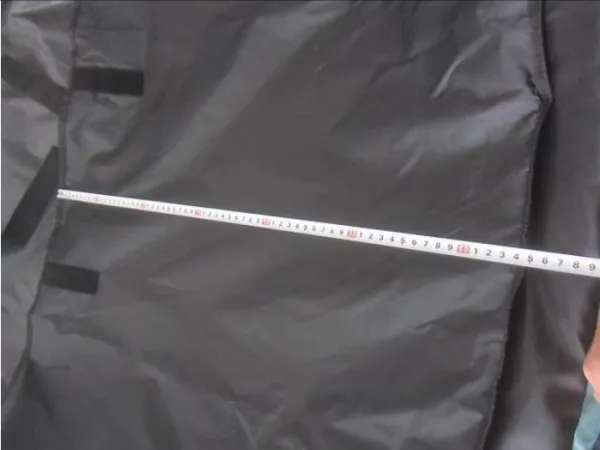
Consistent reference points matter when measuring a flexible insulated bag. The approved packing layout remains the practical fit check.
Compare formats by access and carrying
| Format direction | Useful design questions | Common development risk |
|---|---|---|
| Compact lunch bag | Do meal boxes remain level, and is daily cleaning practical? | Opening too small for the widest container |
| Tote cooler | Does the open geometry need a full zipper, insert or base support? | Heat exchange and shape loss at the top |
| Structured box cooler | How much body and corner support are required? | Reduced usable volume from thick walls and radiused corners |
| Shoulder cooler | Is the packed mass balanced and the strap anchored correctly? | Local panel deformation at strap attachments |
| Cooler backpack | How do the thermal compartment, harness and back panel interact? | Packed contents shift or press against the wearer side |
| Bottle or can carrier | Are dividers, height and opening matched to the container set? | Container movement and concentrated base load |
The format is a starting architecture, not a performance claim. Select it from the contents, access and journey, then test the complete product.
Define every layer of the thermal system
The visible shell, insulation and liner work with seams, joints, closure, geometry and use conditions. Record exact material or supplier references, thickness and tolerance, density where relevant, backing, adhesive or lamination, coverage and side orientation.
BCB03 is a useful first-party source reference because its record identifies a polyester 300D stonewashed exterior, 5 mm EPE foam and PEVA lining. That record describes one product direction only. It does not prove a universal holding time or establish that the same layers suit a new project.
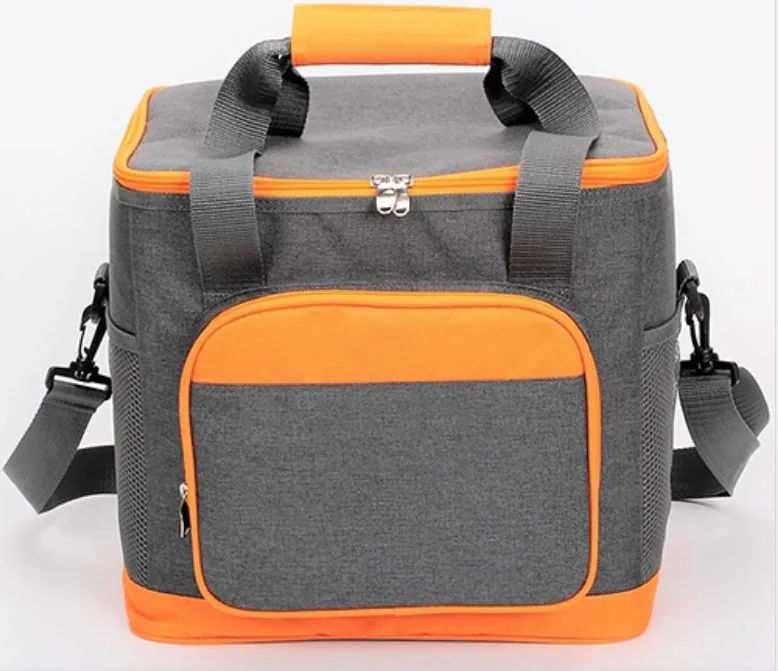
BCB03 illustrates a structured box format with zip lid, dual handles, shoulder strap, front pocket and side mesh. Exact dimensions, materials and performance remain project-specific.
Do not specify insulation by thickness alone
Thickness can affect body and heat transfer, but it does not determine performance alone. Material family, density, compression, gaps, joints, edge construction, closure and bag geometry also matter. Thick insulation compressed at a seam or under binding may create a different path from the centre of a panel.
State whether the controlled value is the insulation layer alone or a total laminate. Define the measurement method, pressure, locations, conditioning and tolerance. Then compare finished samples under the same thermal protocol.
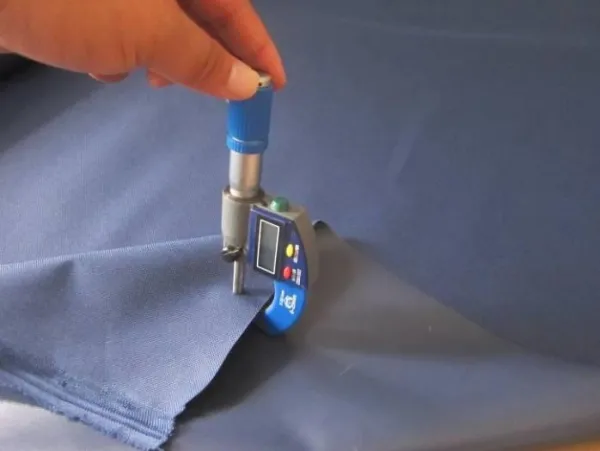
A thickness reading supports material control; it is not a substitute for a finished-bag thermal test.
Match the shell to handling and branding
Woven polyester, nylon, canvas-like fabric, non-woven material, film-coated textile and other constructions can be considered, but each generic name covers multiple grades. Specify composition, yarn or construction where relevant, weight, weave, coating or backing, colour, finish and approved surface reference.
Map expected abrasion, soil, sunlight, rain and cleaning exposure by panel. The base may face different risks from the lid or branded front. If the shell needs a water claim, define the exposure and test the finished bag; a coated fabric does not make sewn seams or zipper openings waterproof.
Branding should be trialled on the exact shell and colour. Heat, ink, embroidery and patches can affect the material or add local stiffness. Approve artwork size, position, colour, hand and the relevant rubbing or cleaning result.
Specify the liner as a complete construction
“PEVA,” “foil” or “silver lining” is not enough. Record the exact film or laminate, backing, thickness, colour or surface, adhesive where applicable, seam or joining method and supplier reference. Visually similar silver materials can have different identities and properties.
BCB08 has a source record identifying polyester 420D, PE foam and PEVA lining. Its product image shows a reflective-looking interior, but appearance alone should not be used to infer composition or performance.
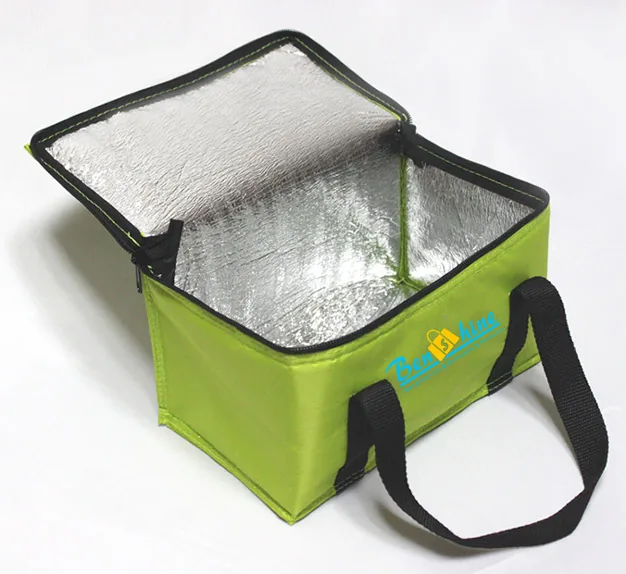
The BCB08 reference helps discuss opening geometry, liner fit, corners and handle routing. New-project material identity and claims require confirmation.
Use the PEVA versus aluminum-foil lining guide for a detailed comparison and evidence checklist.
Design the lid and opening around heat and access
Every opening exchanges air and interrupts the wall system. A wide clamshell lid can improve loading, while a smaller access flap can reduce how much of the compartment opens during use. Neither is automatically better; the choice depends on containers and user procedure.
Define opening shape, clear dimensions, zipper route, flap overlap, puller access and closure sequence. Review gaps at corners and zipper ends. If a two-way zipper is used, check the meeting point and intended parked position.
Test loading and removal with the largest container and with coolant already placed. A lid that closes when empty may become distorted by overfilled contents.
Control seams, corners and insulation continuity
Panel seams, bindings, piping and corners can compress insulation or create gaps. Liner corners can wrinkle or pull. Multi-layer junctions may become stiff and reduce usable space.
Create a cross-section or seam map for lid, sidewalls, base and key corners. Record layer overlap, insulation coverage, seam allowance, binding and joining direction. Define acceptable wrinkles, exposed edges and repair rules.
Stitching creates penetrations and should not be treated as leakproof. If a welded or sealed direction is proposed, specify the compatible material construction and validate the exact finished assembly.
Leakage and condensation are separate issues
Leakage can come from an internal spill, melting coolant or external water. Condensation can form because of temperature and humidity even without a liner leak. Define which event the bag must manage.
A leakage protocol should state liquid amount, temperature, dwell time, orientation, movement, closure and allowed result. Test liner seams, corners and penetrations in the complete bag. Do not use thermal performance as leakage evidence or leakage performance as thermal evidence.
Plan for condensation at the exterior, base and around openings. State whether moisture marks, dripping or surface transfer are acceptable under defined conditions.
Food-contact scope must identify the actual contact
Many cooler bags carry packaged food or closed drink containers. That is different from direct contact between contents and liner. Identify whether contact is packaged, incidental, repeated, direct or not intended.
For direct-contact requirements, define food type or simulant, temperature, duration, market and exact contacting material. Evidence must match the production material and scope. A lining name, silver appearance or general declaration does not make the complete bag food-contact approved.
Also define cleaning and drying after spills. A material can have relevant documentation while corners or seams remain difficult to clean in the intended workflow.
Build compartments around temperature and access zones
Dividers, bottle loops, pockets and separate compartments can organize contents, but they also occupy volume and affect airflow. Define whether a divider is fixed, adjustable or removable and whether it must be insulated.
External pockets should not be assumed to share the thermal condition of the main compartment. If a top dry pocket, utensil pocket or separate warm/cold zone is required, map its layers and closure separately.
Load all zones together during sample review. A full front pocket can deform the main compartment or shift the centre of gravity.
Add structure only where the use requires it
Foam, boards, frames, inserts and reinforced bases can help maintain shape or distribute load, but they add weight, thickness and cleaning interfaces. Define whether the bag must stand empty, remain upright when loaded or collapse for storage.
Specify support material, dimensions, location, removability and edge treatment. Check whether a board creates a thermal bridge, puncture risk or trapped-cleaning zone. If removable, define retention and user instructions.
Review the base using the actual container load. A flat empty bag does not reveal sagging, corner lift or panel bulging.
Engineer the carrying system for packed mass
Calculate or weigh the complete load: contents, containers, coolant, inserts and bag. Define carry distance, hand, shoulder or backpack mode and expected user interaction. Handles, straps, hardware, attachment panels and reinforcement form one load path.
BCB03 visually demonstrates multiple carrying directions, but no image proves a load rating. Specify webbing, width, length, padding, hardware and attachment geometry, then test the finished bag under a written load or cycle protocol.
For backpacks, assess strap position, back-panel shape and content movement. For totes and shoulder bags, inspect balance and panel deformation. Comfort remains user- and condition-dependent and should be evaluated in the intended scenario.
Treat cleaning and drying as design inputs
Define the likely spill, cleaning frequency, wipe or wash method, detergent or chemical, temperature and drying process. Shell, liner, insulation, support, zipper, thread, ink and adhesive may respond differently.
Review corner access, removable inserts, seam ledges and pocket drainage. If the bag must be inverted or held open to dry, verify that the construction allows it. Avoid “easy to clean” without a defined procedure and acceptance criterion.
After cleaning trials, inspect odour, staining, delamination, cracking, colour change, dimensions, zipper function and trapped moisture as relevant. Do not infer hygiene from a smooth liner alone.
Define hot and cold uses separately
A product used for chilled drinks is not automatically suitable for hot food. Temperature exposure can affect liner, adhesive, insulation, shell, print and user handling. Define contents, starting temperature, duration and contact condition for each direction.
Use separate protocols for hot and cold scenarios. Do not average or combine results. If both uses are required, the bill of materials and evidence must cover both specified conditions.
Avoid vague promises about maintaining an ideal temperature. State a controlled result only after testing the complete approved construction under the named procedure.
Write a repeatable thermal test protocol
Include:
- sample and bill-of-material revision;
- preconditioning of bag, contents and coolant;
- ambient temperature, humidity and exposure;
- starting temperatures;
- contents or simulant, mass and container;
- coolant or heat-source type, mass and placement;
- packing arrangement and unused volume;
- probe type, calibration status and fixed locations;
- closure method and opening schedule;
- bag orientation and movement;
- reading interval and total duration;
- pass criteria, sample count and reporting format.
Keep non-construction variables consistent when comparing samples. If bag size, contents, coolant and ambient condition all change, the result cannot be attributed to one layer.
Packaging can compress the thermal system
Folding can crease liners, compress insulation, bend supports and mark coatings. Define fold sequence, insert, individual packaging, carton quantity and orientation. A highly compressed pack-out may reduce shipping volume while changing sample recovery or presentation.
Run a packing trial using the intended production materials. After the defined storage or transit simulation, reopen the bag and inspect dimensions, shape, liner, insulation recovery, zipper, artwork and supports. If recovery time is allowed, state it.
Approve cooler bags in controlled stages
- Use brief: contents, journey, ambient exposure, opening and cleaning.
- Packing layout: usable dimensions, clear opening, coolant and compartments.
- Material swatches: shell, insulation, liner, supports and evidence.
- Layer and seam mock-up: lamination, joins, corners and compression.
- Finished sample: closure, structure, pockets, carrying, branding and packaging.
- Use-based tests: thermal, leakage, cleaning, load and other named protocols.
- Pre-production sample: freeze pattern, bill of materials, workmanship and pack-out.
A substitution in foam, liner, backing, adhesive, zipper, support, pattern or packaging can affect earlier findings. Use documented change control and repeat relevant approvals.
Production quality-control points
Order-specific inspection can include:
- shell, insulation, liner, support and reinforcement identity;
- material weight, thickness, colour and surface condition;
- insulation coverage, joints and compression points;
- liner fit, seams, corners and penetrations;
- finished external and usable internal dimensions;
- clear opening and container-fit check;
- lid, zipper, puller and closure alignment;
- compartments, dividers, pockets and inserts;
- handles, straps, hardware, base and anchors;
- seams, binding, piping and workmanship;
- artwork size, colour, position and condition;
- defined leakage, thermal, cleaning or load checks;
- folding, packaging, carton and traceability;
- conformity to the approved sample and revision.
Sampling does not prove every unit. Use the custom bag quality-control guide to define incoming, first-piece, in-line and pre-shipment controls.
Custom cooler bag RFQ checklist
Send the manufacturer:
- contents, container dimensions, count and packing layout;
- complete packed mass and coolant details;
- cold, hot or other temperature-use direction;
- starting condition, journey, ambient exposure and openings;
- finished external and usable internal dimensions;
- lunch, tote, box, shoulder, backpack or carrier format;
- exact shell, insulation, liner and support construction;
- layer thickness, density, backing, coverage and tolerances;
- seams, corners, joining and leakage-control direction;
- lid, zipper, flap or other closure;
- compartments, dividers, pockets and inserts;
- handles, straps, hardware, reinforcement and load requirement;
- cleaning, condensation, drying and care workflow;
- packaged or direct food-contact status;
- artwork, labels, instructions and branding method;
- thermal, leakage, cleaning, load and packaging protocols;
- target-market documents and evidence scope;
- approved swatch, sample and change-control requirements;
- quantity by colour, size and version;
- packaging, carton, inspection and delivery requirements.
MOQ, price, feasibility and timing depend on material commitments, insulation, construction, testing, quantity, branding and packaging. Request current project confirmation after the specification is reviewed.
Develop the container and thermal system together
Benshine can review lunch, tote, structured box, shoulder and backpack cooler directions around the actual contents, usable dimensions, thermal layers, access, leakage boundaries, cleaning, carrying, branding, tests and quality controls. Published product records provide format and construction references; exact claims and commercial terms remain project-specific.
Explore custom cooler bags, review the BCB03 structured cooler reference and BCB08 liner reference, or send your cooler bag specification.
Quick answers
What information is needed to design a custom cooler bag?
Define the containers and contents, count and orientation, packed mass, starting condition, journey, ambient exposure, opening schedule and cleaning workflow. Then specify usable dimensions, shell, insulation, liner, closure, carrying, branding, packaging and each required test.
How should cooler bag size and capacity be specified?
Provide container dimensions and a packing layout, then control usable internal length, width, height and clear opening. External dimensions and litre claims do not establish real capacity because insulation, seams, corners, supports and pockets consume space. Confirm with a loaded finished sample.
Does thicker insulation always keep a cooler bag cold longer?
No. Material type, density, compression, coverage, joints, seams, closure, bag geometry, contents, coolant and test conditions also affect the result. Compare complete finished samples under one written thermal protocol.
Is a cooler bag automatically leakproof or food-contact suitable?
No. Leakage depends on liner construction, seams, corners, openings and test conditions. Food-contact suitability depends on the exact contacting material, intended contact, temperature, duration, market and evidence. These claims require separate review.
Which cooler bag format is best?
There is no universal best format. Lunch bags, totes, box coolers, backpacks and bottle carriers create different access, load, volume, carrying and thermal conditions. Select the format from the contents and journey, then validate the complete sample.
What belongs in a cooler bag RFQ?
Include contents and packing layout, usable dimensions, temperature-use direction, shell, insulation and liner construction, closure, seams, supports, compartments, carrying, cleaning, branding, thermal and leakage protocols, evidence requirements, quantity, packaging and delivery requirements.