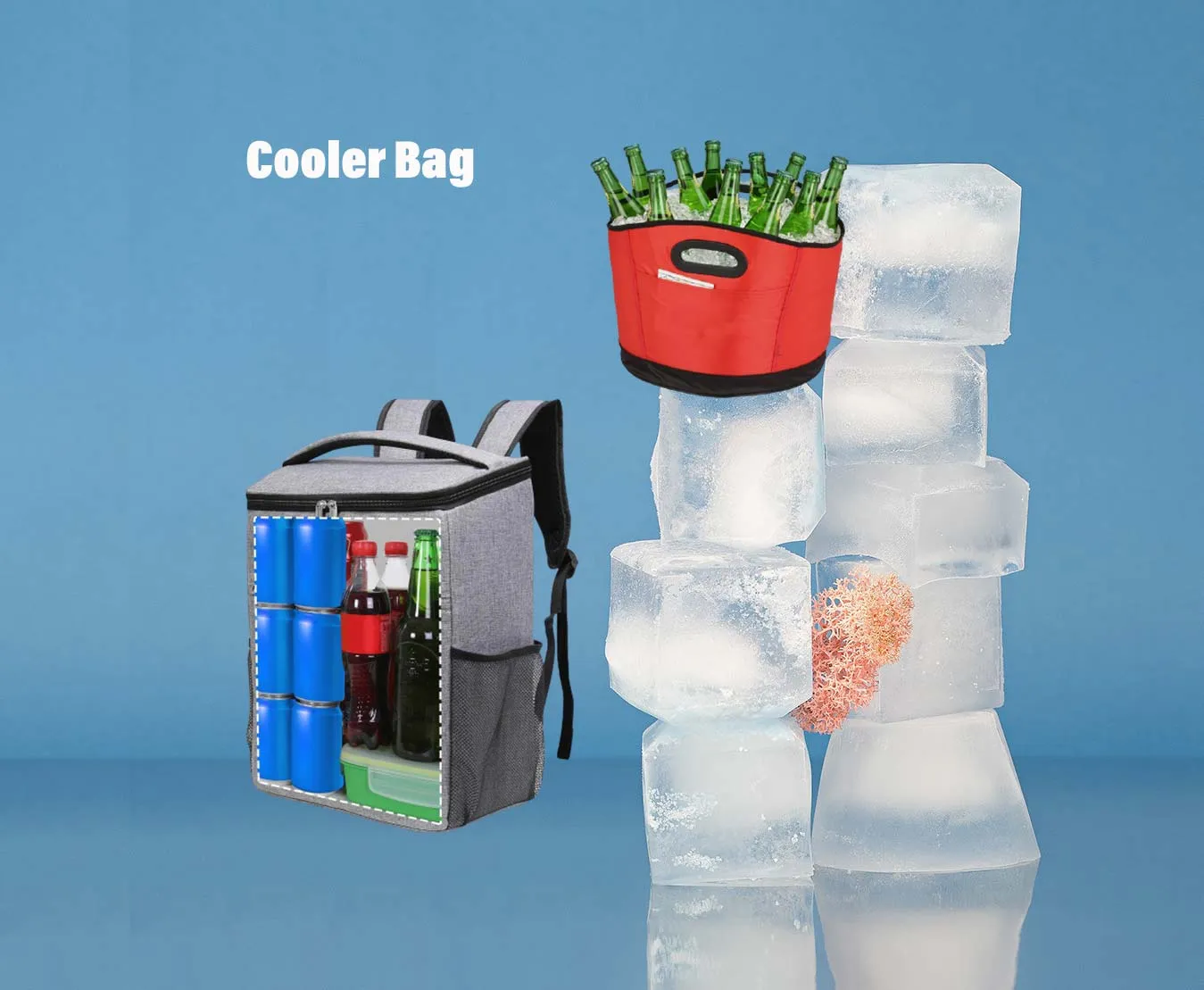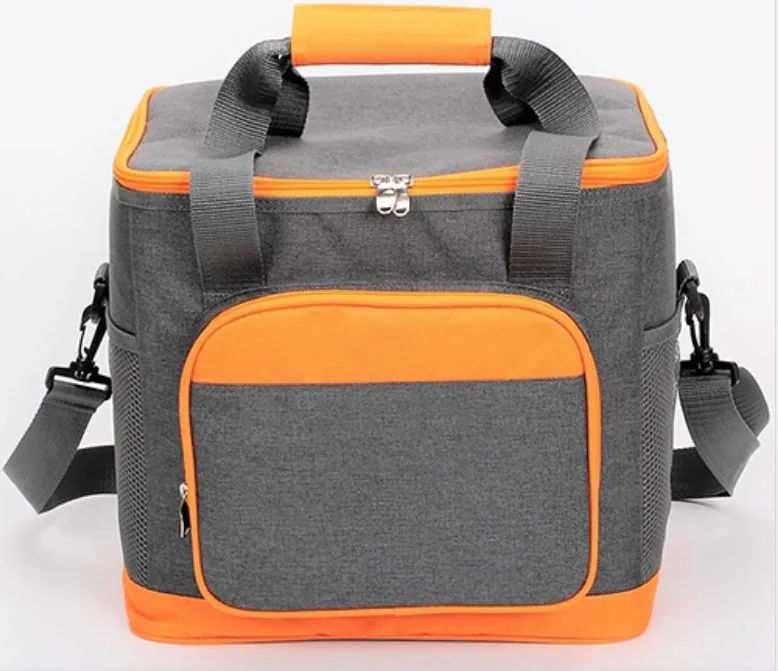
An insulated cooler bag is a soft-sided thermal container, but “insulated” does not state how long it will maintain a temperature or under which conditions. Performance comes from the complete construction and the way the bag is packed, carried and opened.
Direct answer: An insulated cooler bag slows heat transfer through its exterior shell, insulation layer, interior liner, seam paths, closure and compartment geometry. To specify one, begin with the contents and journey, then control every layer, opening and construction detail. Validate the finished sample using the same ambient conditions, starting temperatures, coolant, fill level, opening schedule, probe positions and acceptance rule required by the project.
Insulated cooler bag construction at a glance
| System element | Main role | What the buyer should control |
|---|---|---|
| Exterior shell | Handles wear, appearance, branding and environmental exposure | Material construction, colour, coating, abrasion direction and care |
| Insulation | Slows conductive heat transfer and can add body | Material, thickness, density, coverage, joints and compression |
| Interior liner | Forms the inner surface and cleaning interface | Exact laminate, surface, seams, puncture risk and evidence scope |
| Seam and edge system | Joins panels and can create compressed or interrupted paths | Stitching, welding, binding, overlap and corner details |
| Lid and closure | Controls access and air exchange | Opening geometry, zipper or closure, fit, gaps and user procedure |
| Structure | Holds shape and supports contents | Board, foam, reinforcement, base and removable inserts |
| Carrying system | Transfers packed load to handles or straps | Attachment, reinforcement, hardware and representative load test |
| Use protocol | Determines the real thermal challenge | Contents, coolant, ambient exposure, duration and opening frequency |
Treat these elements as one system. A strong result in one layer cannot compensate automatically for a wide opening, compressed insulation or a different test condition.
Heat can move through several paths
Temperature change can involve conduction through materials, convection through moving air and radiative exchange between surfaces. In a soft cooler, practical heat paths can include:
- broad shell, insulation and liner panels;
- compressed areas around seams and piping;
- uninsulated or thin corners;
- gaps around a zipper or lid;
- the opening each time the bag is accessed;
- direct contact between contents and a warm or cold surface;
- hardware, support and attachment paths;
- unused internal air space;
- solar exposure on the exterior.
The goal is not to eliminate all heat transfer. It is to design and verify a bag that meets a defined requirement under stated conditions.
Start with contents and the full journey
Before discussing foam or lining, define what the bag carries:
- container dimensions, count and orientation;
- packed, sealed or direct-contact contents;
- starting temperature range;
- coolant type, size, quantity and position, if used;
- packed weight;
- journey duration;
- ambient temperature and exposure direction;
- time spent in sun, shade, vehicle or indoor conditions;
- number and duration of openings;
- acceptable end condition;
- cleaning and turnaround workflow.
A lunch bag opened several times is a different problem from a beverage carrier that stays closed. A medical or pharmaceutical use also requires product-specific risk, temperature and regulatory controls that cannot be inferred from a consumer cooler-bag construction.
The shell is more than decoration
The exterior may use polyester, nylon, canvas, nonwoven material, laminated film, tarpaulin or another controlled construction. Select it around:
- abrasion and handling exposure;
- colour and branding method;
- coating or laminate direction;
- cleaning and stain visibility;
- seam and attachment compatibility;
- required hand, structure and folding behaviour;
- water-exposure claim, if any;
- evidence needed for the destination market.
The shell can affect solar absorption, moisture exposure, sewing and overall structure, but the fiber name alone does not establish thermal performance. Use the nylon versus polyester guide when comparing woven shell directions.
The insulation layer must be specified independently
Foam, fiber and other insulation directions vary by material family and supplier construction. Record:
- supplier and material code;
- nominal thickness and tolerance;
- density or another relevant physical field;
- sheet, roll or molded direction;
- compression and recovery expectations;
- coverage across walls, lid, base and dividers;
- joint, overlap and gap treatment;
- compatibility with shell, liner and adhesives;
- condition after folding, packing or loaded use;
- applicable material and finished-product tests.
Thicker insulation is not automatically better. Extra thickness can reduce usable space, increase corner bulk, interfere with closure and become compressed in seams. Compare representative finished constructions under the same protocol.
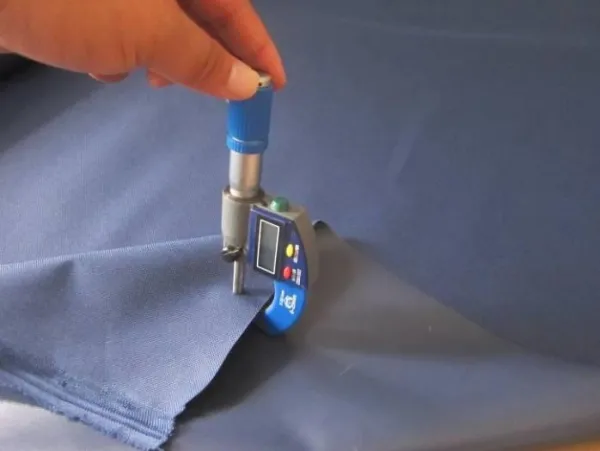
A thickness value is meaningful only when the material, conditioning, tool, location, method and tolerance are defined. It does not by itself predict finished-bag temperature performance.
The lining is the interior interface
PEVA, foil-style laminates and other liners can provide different surface, appearance, flexibility, joining and cleaning directions. Do not identify a liner from silver colour alone.
Control:
- exact material or laminate construction;
- exposed face and backing layers;
- thickness, colour, texture and gloss;
- supplier code and substitution rules;
- seam, weld or bonding direction;
- fold, puncture and abrasion exposure;
- cleaner compatibility and drying method;
- packaged or direct-contact contents;
- documents relevant to the exact grade and intended market.
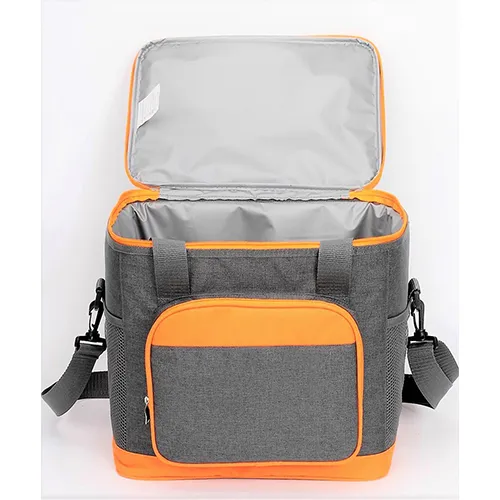
The BCB03 source record identifies a polyester shell, 5 mm EPE foam and PEVA lining direction. That record is a product-development reference, not a universal thermal, leakproof or food-contact claim. See the BCB03 product reference.
For liner-specific decisions, compare PEVA and aluminum-foil-style cooler bag linings.
A three-layer description is only the beginning
Cooler bags are often summarized as outer shell + insulation + lining. That is useful for orientation, but a production specification needs more detail.
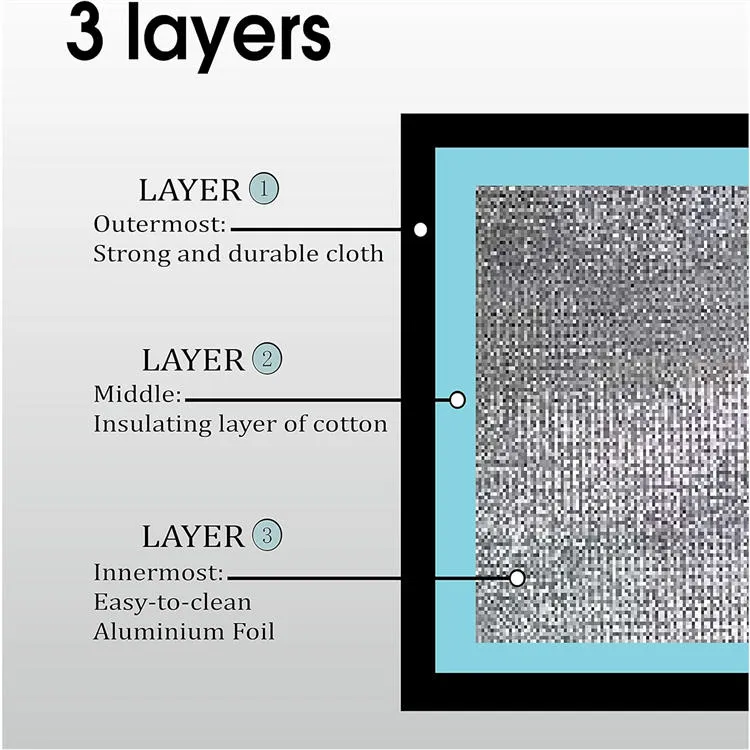
The JA019 source graphic illustrates three functional layer positions. Generic labels in a graphic should not replace the exact bill of materials, supplier codes, thicknesses, joins and evidence for the proposed bag.
Also account for:
- adhesives or lamination between layers;
- binding, piping and seam allowances;
- reinforcement around handles and straps;
- base board or support inserts;
- pocket panels outside the thermal compartment;
- dividers or separate temperature zones;
- zipper tape, lid facing and closure flaps;
- labels or artwork applied to the liner or shell.
Record every relevant layer in the bill of materials and construction drawing.
Seams, corners and compressed zones can become thermal bridges
Where multiple panels meet, insulation may be cut, compressed, overlapped or omitted. These local paths can behave differently from a broad wall panel.
Review:
- wall-to-base and wall-to-lid transitions;
- sharp versus radiused corners;
- insulation overlap or butt joints;
- piping and binding compression;
- stitch paths crossing the layer stack;
- handle anchors and reinforcement patches;
- zipper installation and lid edge;
- removable liner or insert interfaces;
- folds created for shipping.
An insulation swatch test does not capture these finished-bag details. Use section drawings and representative prototypes.
The lid and closure control air exchange
A wide top opening improves access but can exchange more internal air each time it is opened. Closure decisions include:
- zipper chain and tape direction;
- one-way or two-way slider arrangement;
- lid overlap and corner fit;
- flap or hook-and-loop additions;
- roll-top or drawcord direction;
- hard or soft lid structure;
- gasket-like features where relevant;
- user closing procedure;
- opening frequency in the thermal test.
A zipper name alone does not prove a sealed compartment. Inspect the complete perimeter, end transitions and closed geometry.
Compartment geometry and fill level affect the result
Two bags made from the same layers can perform differently when their surface area, shape, opening or unused volume differs.
Consider:
- internal width, height and depth;
- actual usable volume after lining and insulation;
- surface-area-to-volume direction;
- rigid versus soft shape;
- dead space around the contents;
- position of coolant and probes;
- divider continuity;
- lid depth and contact with the load;
- container orientation and contact points.
Do not compare a compact, fully packed sample with a larger, lightly filled sample and attribute the result only to the insulation.
Cold and hot uses require separate protocols
“Keeps cold items cold and hot items hot” is not one testable claim. Cold and hot applications can use different:
- starting temperatures;
- contents and container materials;
- coolant or heat source;
- ambient conditions;
- safety boundaries;
- closure and opening schedules;
- probe positions;
- end-temperature criteria;
- handling and user instructions.
Test the intended direction. Evidence from a cold-pack comparison should not automatically be extended to hot-food transport, and vice versa.
Leakage and thermal performance are separate claims
A liner may support cleaning and resist liquid through its face while stitched corners, zipper openings or punctures still allow leakage. Conversely, a thermally useful construction may not be designed to hold free liquid.
Define whether the requirement is:
- external rain resistance;
- management of condensation;
- containment of a small internal spill;
- no visible leakage under a defined fill-and-hold method;
- washable or rinseable construction;
- no free-liquid containment claim at all.
State the liquid, temperature, fill level, orientation, duration, movement and acceptable result. Do not use “leakproof” as a substitute for a written method.
Food-contact evidence begins with intended contact
Packaged food, closed bottles and direct contact with unpackaged food create different evidence questions. Record:
- whether contents touch the liner;
- food type where relevant;
- contact time and temperature;
- single or repeated-use direction;
- cleaning conditions;
- target market;
- exact liner grade, colour, adhesive and printed surface;
- supplier declarations and testing required;
- formulation and source change control.
A report for one material or layer does not automatically apply to another laminate or complete bag. Review the exact sample, method, date and scope on the quality and test-document page.
Cleaning, condensation and drying need design input
Plan the internal workflow instead of adding generic “easy to clean” language. Questions include:
- Can the user reach every corner and seam?
- Where does condensation collect?
- Can liquid migrate into foam or board through a seam?
- Is the liner fixed, removable or reversible?
- Which cleaner, concentration and temperature are intended?
- Is wiping, rinsing or washing allowed?
- How does the bag drain and dry?
- Can the closure remain open during drying?
- Do prints, coatings, adhesives and support layers tolerate the method?
Approve care instructions on the exact construction. A smooth silver surface is not proof of hygiene, washability or odour control.
Carrying and structure must suit the packed load
Insulation does not replace structural planning. Define:
- packed weight and content distribution;
- tote, handle, shoulder or backpack carrying direction;
- handle drop and grip area;
- strap width, adjustment and hardware;
- attachment geometry and reinforcement;
- base support and standing requirement;
- pocket loads outside the thermal compartment;
- representative carrying or attachment tests.
Loaded performance is project-specific. A product photo does not establish a load rating, comfort level or carrying distance.
Build a comparable cooler bag temperature test
Write the protocol before approving marketing language. Record:
- sample identity, pattern and bill-of-material revision;
- preconditioning of the bag, contents and coolant;
- ambient temperature, humidity and exposure direction;
- starting temperature of contents, bag and coolant;
- content or simulant type, mass and container;
- coolant type, size, mass, temperature and placement;
- fill arrangement and unused internal volume;
- probe type, calibration status and fixed locations;
- closure procedure and opening schedule;
- bag orientation, movement and solar exposure;
- reading interval and total duration;
- pass criteria and treatment of anomalous readings;
- sample quantity and reporting format.
When comparing two constructions, keep all non-construction variables as consistent as practical. If foam, bag size, content mass and opening schedule all differ, the result cannot be assigned to one material change.
Approve materials and finished samples in stages
- Material swatches: confirm identity, thickness, hand, surface and documentation.
- Layer mock-up: review lamination, joining, compression and edge finish.
- Compartment prototype: inspect liner fit, corners, closure and cleanability.
- Finished bag: include handles, pockets, supports, branding and packaging effects.
- Use-based tests: apply thermal, leak, cleaning, seam and load protocols as required.
- Pre-production sample: freeze bill of materials, pattern, workmanship and acceptance criteria.
A substitution in foam, liner, backing, adhesive, zipper, support or pattern can affect earlier conclusions. Use documented change control.
Production quality-control points
Order-specific checks may include:
- shell, insulation and liner material identity;
- colour, surface and visible damage;
- thickness under an agreed method;
- insulation coverage and joint placement;
- liner pattern, fit, seams and punctures;
- corner, binding and piping construction;
- lid, zipper and closure alignment;
- handle, strap and base reinforcement;
- compartment dimensions and usable opening;
- defined leakage or functional sample check;
- project-specific thermal verification;
- cleanliness, dryness and packing condition;
- traceability to the approved sample and tested lot.
Sampling does not prove every unit. Use the custom bag quality-control guide to define defect rules, inspection stages, rework and release.
Insulated cooler bag RFQ checklist
Send the manufacturer:
- intended contents, container dimensions and packed weight;
- cold, hot or other temperature-control direction;
- starting and acceptable end condition;
- journey, ambient exposure and opening schedule;
- coolant or heat-source details, if used;
- finished external and usable internal dimensions;
- shell, insulation and liner construction preferences;
- layer thickness, density, coverage and support requirements;
- seam, corner and joining direction;
- lid, zipper, flap or other closure;
- pockets, dividers and separate zones;
- handles, straps, hardware and load requirement;
- cleaning, condensation and drying workflow;
- packaged or direct food-contact status;
- thermal, leakage, cleaning, seam and load test protocols;
- target-market evidence requirements;
- branding, labels, instructions and packaging;
- approved sample and change-control requirements;
- quantity by colour and version;
- delivery requirements.
MOQ, price, feasibility and timing depend on the exact materials, insulation, construction, testing, quantity, branding and packaging. Request current project confirmation.
Specify the thermal system, not only the cooler-bag shape
Benshine can review intended contents, cooler-bag format, compartment geometry, shell, insulation, lining, carrying, cleaning, test methods and approval requirements. Performance claims should follow controlled finished-product evidence.
Explore custom cooler bags, compare cooler bag lining materials, or send your insulated bag specification.
Quick answers
How does an insulated cooler bag work?
A cooler bag slows heat transfer through a system of exterior shell, insulation, lining, seams, closure and compartment geometry. Results also depend on starting temperatures, contents, coolant, fill level, ambient conditions and opening frequency. No single lining or foam layer determines performance.
What layers are used in an insulated cooler bag?
A common direction includes an exterior textile or film, an insulation layer and an interior liner, with support or reinforcement added where needed. The exact material family, thickness, density, backing, adhesive, seam method and coverage must be specified for each project.
Does thicker foam always keep a cooler bag cold longer?
Not automatically. Thickness can matter, but density, material type, compression, gaps, seam bridges, closure, bag geometry, contents and test conditions also influence the result. Compare complete finished samples under one controlled protocol.
Does a silver lining prove that a cooler bag is insulated?
No. Silver appearance does not identify the exact material or establish a holding time. The visible liner is only one layer, and similar-looking materials can have different constructions. Confirm the bill of materials and test the complete bag.
Is an insulated cooler bag automatically leakproof or food-contact suitable?
No. Leak control depends on liner construction, seams, punctures, openings and test conditions. Food-contact suitability depends on the exact material, intended contact, temperature, duration, market and applicable evidence. Thermal, leakage and food-contact claims require separate review.
How should cooler bag temperature performance be tested?
Use a written protocol covering sample revision, ambient conditions, starting temperatures, contents or simulant, coolant, fill arrangement, probe locations, closure and opening schedule, orientation, duration and pass criteria. Use the same method when comparing constructions.