REACH is not a single “pass” label for a factory or an entire product library. For a custom bag, compliance work starts with the exact product, every material and component, its destination and the current legal requirements. Evidence must match the approved bill of materials and remain traceable through production.
Direct answer: Review REACH for a bag component by component and requirement by requirement. Check applicable Annex XVII restrictions, current Candidate List duties and any other buyer or market requirements. A historical test report proves only its named samples, scope, methods, limits and date; it cannot establish blanket compliance for every bag or future production.
REACH evidence at a glance
| Question | Controlled input | What not to assume |
|---|---|---|
| What product? | SKU, revision, intended user, market and use | One factory-level certificate covers all products |
| What materials? | Complete BOM, supplier codes, colours and lots | Main fabric represents every component |
| Which rules? | Current Annex XVII entries, Candidate List and other scope | An old substance list remains current |
| What evidence? | Declarations, traceability, reports and risk-based tests | One “REACH report” covers every obligation |
| What changed? | Supplier, colour, coating, print, hardware or regulation | Previous results transfer after substitution |
| Who is responsible? | Manufacturer, exporter, importer, distributor and adviser | The factory alone owns every EU-market duty |
This is practical sourcing guidance, not legal advice. The responsible EU/EEA economic operator should confirm the current requirements for the exact article and market with qualified compliance support.
Start with the exact legal question
“Meet REACH” is too broad to be a useful test instruction. Define the destination, placing-on-market date, product type, intended users and company roles. Identify whether the project needs an Annex XVII restriction review, Candidate List assessment, Article 33 communication, ECHA notification analysis, SCIP work or other chemical and product rules.
The official ECHA restricted-substances table presents Annex XVII entries and their conditions. The ECHA Candidate List obligations summary explains that Candidate List inclusion can create duties for substances in articles. Always work from the current official version rather than copying a list from an old report.
Annex XVII and the Candidate List are different
Annex XVII restricts the manufacture, placing on the market or use of specified substances, mixtures or articles under conditions written for each entry. Applicability can depend on material, concentration, accessible part, skin contact, consumer use, age group or another condition.
The Candidate List identifies substances of very high concern. For articles containing a Candidate List substance above the applicable concentration threshold, communication and other duties may apply. Candidate List status is not the same as an Annex XVII restriction, and a result for one does not replace review of the other.
Build a requirements matrix that cites the entry or list version, material or article boundary, method, limit, reporting rule and responsible party.
Understand the 0.1% article threshold carefully
ECHA states that suppliers of articles containing a Candidate List substance above 0.1% weight by weight must provide sufficient safe-use information to professional recipients, and consumers can request information. ECHA also describes notification conditions involving the 0.1% threshold and annual tonnage.
A bag is a complex object assembled from multiple articles and materials. Do not average a component result across the whole bag without confirming the correct article-level interpretation. Zipper pullers, buckles, patches or coated panels can need separate consideration even when their mass is small compared with the finished product.
Use ECHA’s Candidate List substances in articles guidance and obtain qualified review for the current product structure.
Keep SCIP duties separate from REACH testing
SCIP is established under the EU Waste Framework Directive, although it uses Candidate List information. ECHA describes SCIP notifications for articles containing Candidate List SVHCs above 0.1% w/w that are placed on the EU market. A laboratory report does not itself complete a SCIP submission.
The responsible EU supplier must determine whether a submission is required and prepare article identity, material or mixture category, substance, concentration range, safe-use and hierarchy information as applicable. Review the official ECHA SCIP database and information for current requirements.
Do not market “SCIP compliant” simply because a material passed a restricted-substance panel. Testing, duty analysis and submission records are different evidence types.
Map every material and component
Create a compliance bill of materials covering:
- shell and lining textiles by supplier, construction and colour;
- coatings, laminations, films and artificial-leather layers;
- foam, boards, interlinings and adhesives;
- mesh, webbing, elastic, cord, thread and binding;
- zipper chain, tape, sliders, pullers and stops;
- plastic buckles, adjusters, hooks and feet;
- metal rings, rivets, snaps, frames and magnets;
- print inks, transfers, embroidery thread, patches and labels;
- surface treatments, plating, paints and protective finishes;
- packaging where it falls within the agreed compliance scope.
Assign a unique material or component code and supplier. “Black polyester” is not enough to connect a test result to production.
Use product architecture to define article boundaries
Document which components remain distinct articles and how they are assembled into the complex object. A buckle, zipper slider or metal ring can retain its shape and function within the bag. Coatings, inks or adhesives may be mixtures during application and become part of a material or article.
The responsible compliance specialist should confirm the regulatory treatment; the sourcing team should provide an accurate BOM and construction map. Photographs and drawings help connect each evidence record to its location.
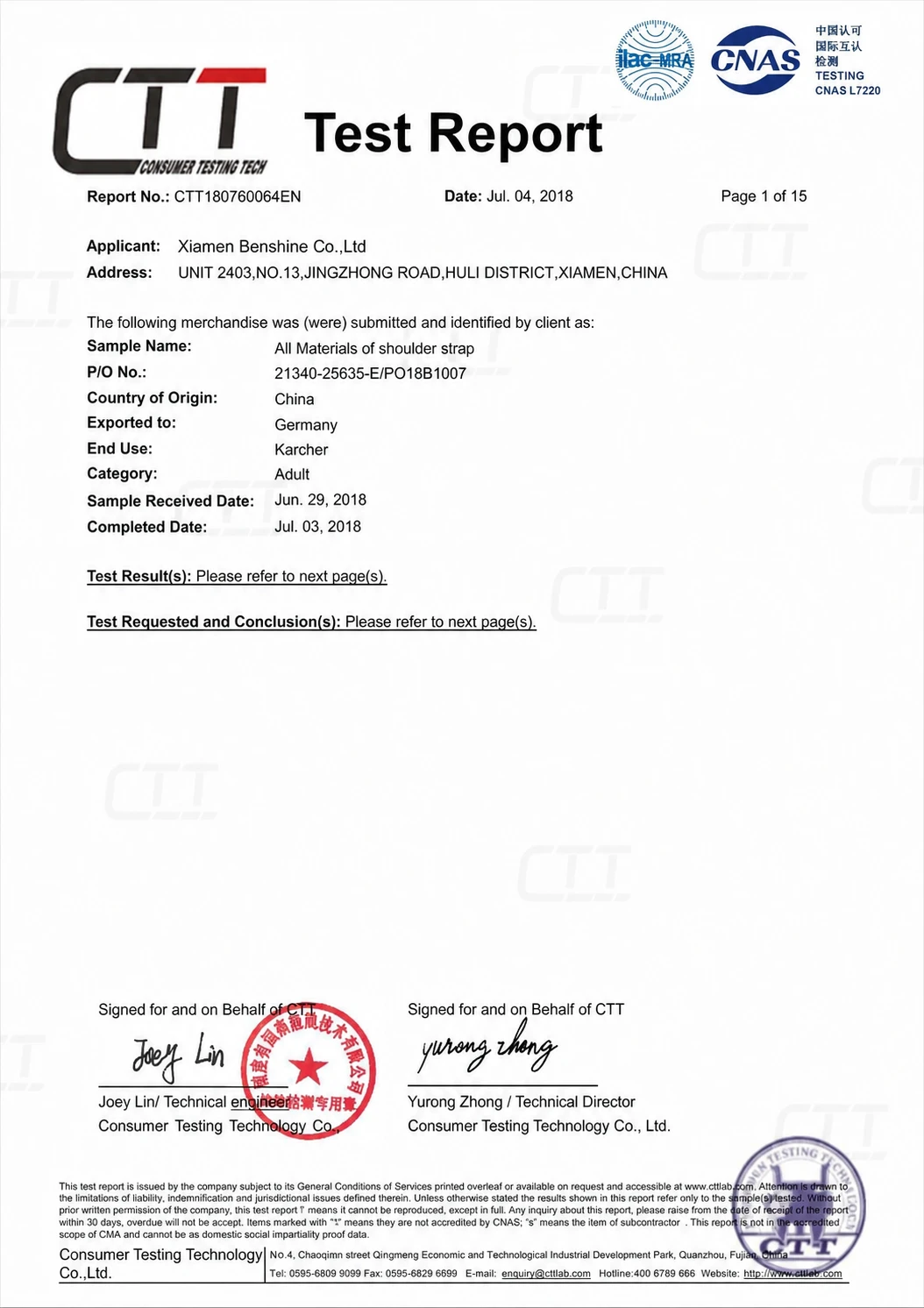
Report CTT180760064EN identifies a particular submitted shoulder-strap material set and 2018 test scope. It is evidence for that sample—not a factory-wide or current-product certificate.
Read a test report by scope, not by headline
Before accepting a report, verify:
- laboratory and report number;
- applicant and client identification;
- sample description, photographs and material details;
- supplier, colour, lot or production reference where available;
- received, test and issue dates;
- requested substances or restriction entries;
- methods, preparation and detection limits;
- applicable limits and age or use assumptions;
- individual results, remarks and exclusions;
- report amendment and authenticity controls.
A “pass” applies only within that scope. It does not cover substances that were not requested, regulatory changes after the test or materials not represented by the sample.
Scope Benshine’s historical report correctly
The available Benshine record CTT180760064EN is a 2018 report for materials of a shoulder strap submitted for a named order and end use. It is not a factory certification, and it does not prove that all current fabrics, colours, coatings, prints, foams, zippers or hardware meet every current REACH requirement.
The report can demonstrate how sample-specific evidence is presented and can support historical traceability for its stated project. A new buyer should define the current product, BOM, restricted-substance scope, list version and sampling plan before relying on or commissioning evidence.
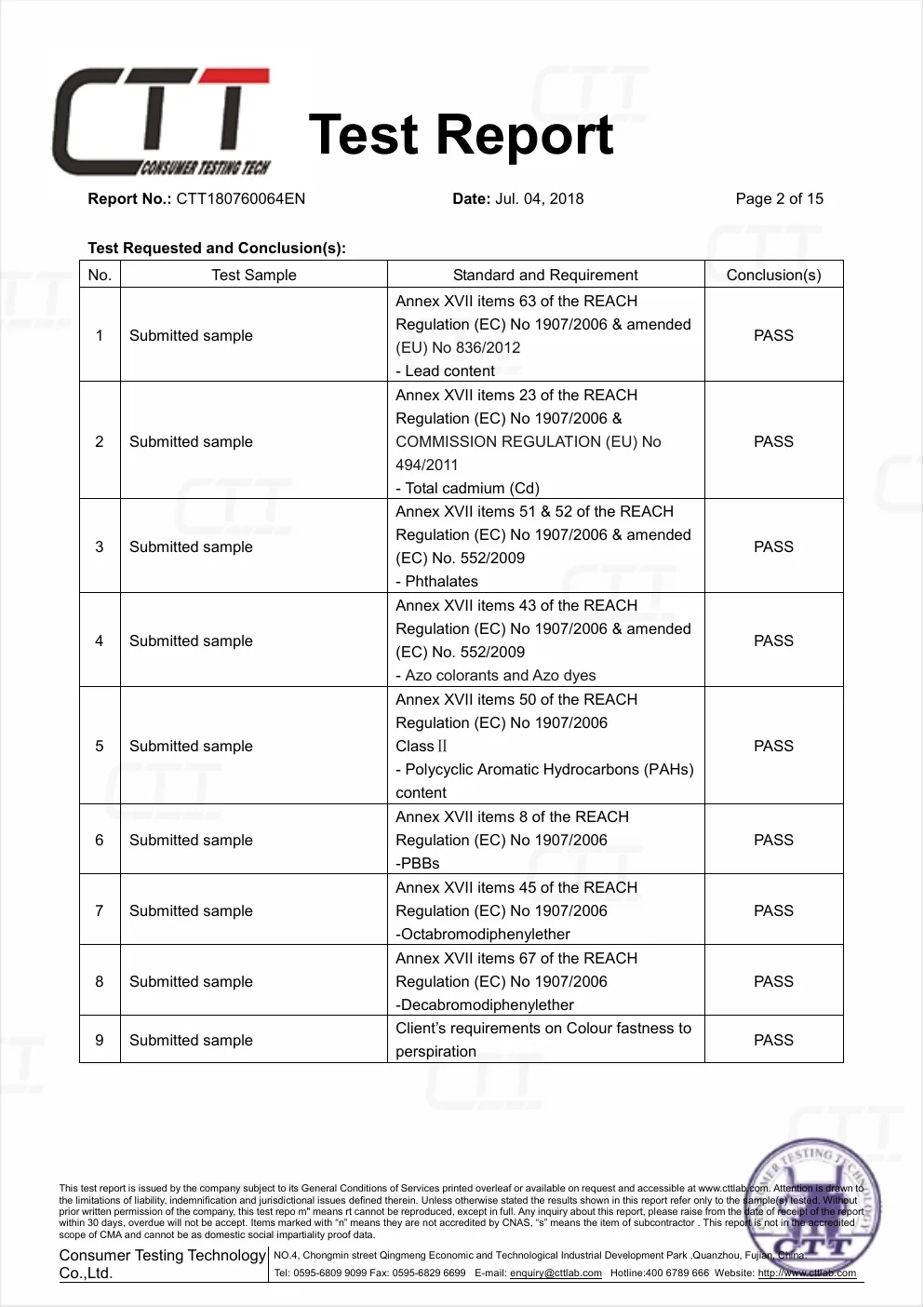
Always read sample identification, requested tests, methods, results and report notes together. A cover-page description alone is insufficient.
Build a risk-based component plan
Not every component presents the same substance risk. Assess material chemistry, colour, coating, printing, plating, plasticization, recycled inputs, skin contact, use and supplier control. Use that assessment to decide which evidence can be grouped and which components need separate verification.
Possible risk areas can include plasticized materials, coated surfaces, metal finishes, pigments, prints, adhesives and elastomers, but applicable substances and limits must come from the current requirements matrix. Do not publish a fixed generic analyte list as if it fits every bag and market.
Document the reason for grouping colours or materials. A result for one colour should not automatically represent other pigments or suppliers.
Coordinate supplier declarations and test reports
Supplier declarations can identify material codes, composition, regulatory list version and change commitments. Test reports can provide analytical results for sampled materials. Neither replaces a complete traceability system.
Require declarations to name the supplier, material, colour or finish, relevant requirement, date and authorized signatory. Compare their scope with the BOM and test plan. Resolve vague wording such as “REACH compliant” that does not identify requirements or versions.
Where certificates or reports are reused, check whether the actual production material is demonstrably the same. Record validity decisions rather than assuming evidence transfers.
Sample production-intent materials
Testing should use materials that represent the approved production construction. Record who selected the sample, where it came from, material code, supplier, colour, lot, date and seal or chain-of-custody information where required.
Pre-production samples may help early decisions, but substitutions can invalidate conclusions. For risk-based production verification, define sampling stage and lot coverage. Keep retained references when useful for investigation.
The laboratory request should cite the current requirement and reporting expectation. “Test REACH” leaves too much interpretation to the requester or laboratory.
Control colour, print and finish variants
Different colourants, inks, transfers, coatings and metal finishes can change chemical risk. Build a variant matrix showing which evidence supports each colour and decoration. If a family is grouped, record the technical rationale and responsible approval.
Test decoration on the actual substrate where the combined construction matters. A compliant blank fabric does not automatically cover an added print or coating. Custom pullers, plated hardware and branded patches should be included in the BOM and review.
Treat recycled materials with the same discipline
Recycled content claims do not establish chemical compliance. Recycled feedstock may introduce different variability and requires supplier control, traceability and risk assessment appropriate to the material and use.
Keep recycled-content evidence separate from REACH evidence. A chain-of-custody document, composition declaration and restricted-substance report answer different questions. Approve each claim against its own boundary.
Use change control throughout production
Supplier, colour, coating, formulation, print, adhesive, zipper, buckle, plating or recycled-content changes can affect the evidence package. Require advance notification and define which changes trigger document review, retesting or buyer approval.
Maintain a compliance matrix linking product revision, BOM component, supplier, evidence document, test sample, requirement version and approval status. Production quality control should verify identity and traceability, not attempt to infer chemistry visually.
Regulatory updates are also changes. Review the Candidate List and Annex XVII at agreed milestones, including before final release when the project timeline is long.
REACH evidence workflow for a custom bag
- Define roles and market: importer, supplier, product, user and placing-on-market timing.
- Freeze the product architecture: BOM, component codes, suppliers, colours and finishes.
- Build the requirements matrix: current Annex XVII, Candidate List and other applicable rules.
- Assess risk: component chemistry, exposure, supplier controls and evidence gaps.
- Collect declarations: match every document to exact materials and versions.
- Approve the test plan: samples, methods, limits, grouping and laboratory reporting.
- Review results: scope, detection limits, exclusions, failures and corrective actions.
- Resolve duties: Article 33, notification or SCIP analysis by the responsible EU actor.
- Freeze production evidence: approved BOM, records, change control and retention.
- Recheck updates: current official lists before release and future repeat orders.
REACH RFQ and compliance checklist
Send the manufacturer and compliance team:
- destination country and placing-on-market date;
- responsible importer, distributor or other economic operator;
- product type, intended user and age group;
- complete component-level BOM and construction drawing;
- supplier, material code, colour, finish and lot controls;
- current Annex XVII entries and Candidate List version to review;
- buyer-specific restricted-substance requirements;
- declaration format and document language;
- testing method, limits, detection requirements and laboratory criteria;
- sample selection, grouping and chain-of-custody plan;
- Article 33, notification and SCIP responsibility;
- failure, substitution and corrective-action process;
- production identity checks and evidence-retention period;
- change-control and repeat-order review rules.
Testing cost, sample count and timing depend on product complexity, BOM, colour and supplier variants, required substances, methods, laboratory and evidence gaps. Confirm the current project after scope review.
Use evidence that matches the exact bag
Benshine can provide product and material information within an agreed project scope and coordinate production-intent samples for buyer-defined testing. The buyer and responsible EU-market actors should define applicable requirements, approve the evidence plan and determine legal duties.
Review the historical shoulder-strap test report, read the factory evidence verification guide, use the custom bag quality-control guide, or send your BOM and compliance scope.
Quick answers
Does one REACH test report prove that every Benshine bag is compliant?
No. A report applies to the identified samples, substances, methods, limits and date. It does not automatically cover other fabrics, coatings, prints, foams, zippers, hardware, suppliers, colours, products or later regulatory updates.
What is the difference between REACH Annex XVII and the Candidate List?
Annex XVII contains restrictions on specified substances, mixtures or articles under defined conditions. Candidate List inclusion can trigger information, notification and related duties for articles containing an SVHC above applicable thresholds. They are different checks and neither can be replaced by the other.
What does the 0.1% w/w SVHC threshold mean for a bag?
ECHA describes Article 33 communication duties for Candidate List substances above 0.1% weight by weight in an article. Complex products require article-level analysis rather than a simple whole-bag average. The responsible EU actor should confirm the current interpretation and duties.
Which bag components should be included in a REACH review?
Map every material and component: shell, lining, coatings, prints, transfers, foam, boards, films, mesh, webbing, elastic, thread, zipper, pullers, buckles, metal parts, labels, patches, adhesives and packaging where relevant to scope.
Is supplier declaration enough for REACH compliance?
A declaration can support the evidence package but may not be sufficient alone. Check supplier identity, material code, colour, restricted-substance scope, list version, date and traceability, then use risk-based testing or other verification where required.
What should a buyer send for a bag REACH compliance review?
Provide destination market, responsible importer or supplier, product and age group, complete bill of materials, supplier and colour references, intended claims, current restricted-substance list, required methods and limits, sample plan, document format and change-control rules.