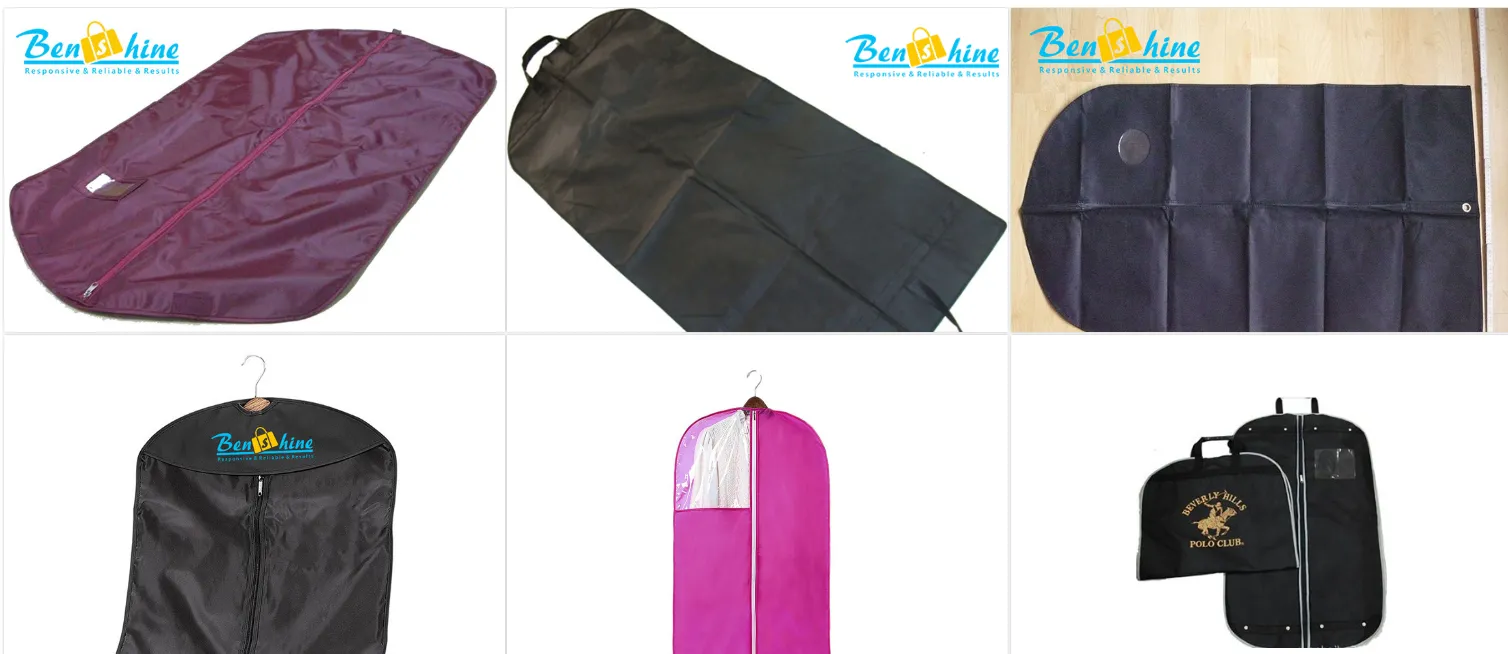
A garment bag can be a simple hanging cover, a gusseted wardrobe organizer, a retail presentation cover or a foldable travel carrier. Those formats may look related, but their fit, access, materials, carrying and quality risks are different. The specification should begin with the garment and handling process, not a generic bag size.
Direct answer: A useful garment bag design starts with the loaded garment length, shoulder width, thickness, hanger and pieces per bag. Define usable dimensions, gusset, hanger opening, zipper access, materials, window, folding and carrying around that content. “Garment bag” alone does not prove fit, breathability, dust or moisture protection, wrinkle prevention, colour safety, load capacity or durability.
Garment bag specification at a glance
| Decision | Buyer input | What not to assume |
|---|---|---|
| Garment set | Type, quantity, dimensions, thickness and packed arrangement | That one standard cover fits every suit, dress or coat |
| Hanger | Width, thickness, hook geometry and orientation | That every hanger slot works with every hook |
| Capacity | Flat or gusseted, usable depth and closure clearance | That external dimensions equal usable internal space |
| Access | Front, side or wrap opening; zipper length and direction | That a long zipper automatically gives snag-free access |
| Materials | Exact shell, window, lining, binding and reinforcement | Breathability, barrier or composition from a generic name |
| Carrying | Hanging only, foldable, handles, strap and attachment | A safe load or balanced carry from appearance |
| Branding | Artwork, display orientation, fold lines and pack-out | That a logo remains visible when folded or displayed |
| Evidence | Named test, sample revision, condition and pass rule | Universal protection, compliance or commercial terms |
Use representative garments throughout development. A flat drawing cannot reveal fabric compression, hem bunching, hanger movement, zipper interference or how the cover hangs under its real contents.
Begin with the garment and workflow
Identify what the cover must hold: jacket, trouser set, dress, coat, robe, uniform, costume or several garments. Record how the product moves from packing to final use. Retail delivery, wardrobe storage, hotel service, uniform distribution and travel create different access, identification and handling needs.
Document whether garments enter already on hangers, whether users need repeated access, whether the cover remains vertical, and whether it must fold or carry accessories. Note contact with racks, vehicles, luggage or shelving. These details determine which functions belong in the product rather than being added after sampling.
Measure the loaded garment, not only the label size
Garment size labels do not provide a complete bag dimension. Measure the actual loaded set on the intended hanger:
- top of hanger or defined hook reference to lowest hem;
- maximum shoulder or sleeve width;
- body and hem width where relevant;
- front-to-back thickness at the fullest location;
- number of pieces and their arrangement;
- hanger width, body thickness, hook diameter and hook height;
- accessories or folded components stored with the garment;
- clearance needed for insertion, removal and closure.
Define whether the garment may touch the bottom or whether clearance is required. Long dresses, trains, structured shoulders and thick coats may need special geometry. Approve fit using the production-intent garment set, not only a tape-measure calculation.
Distinguish external size from usable internal space
Finished external length and width do not equal usable capacity. Seams, binding, zipper tape, curved shoulders, bottom shape and material thickness consume space. A hanger opening can also shift the garment down or sideways.
Create an annotated drawing with finished outside dimensions, usable internal dimensions, seam allowances where controlled, hanger reference and measurement condition. State whether the bag is empty, hanging or loaded when measured. Use consistent points at the top curve, sides and bottom.
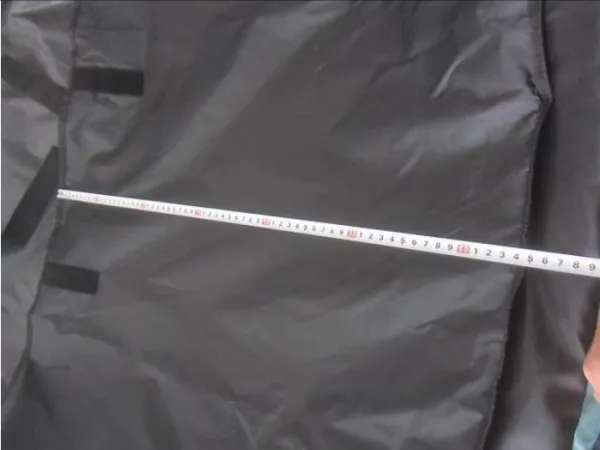
Finished measurements need named reference points and a consistent bag condition; a flexible empty panel is not the same as usable loaded space.
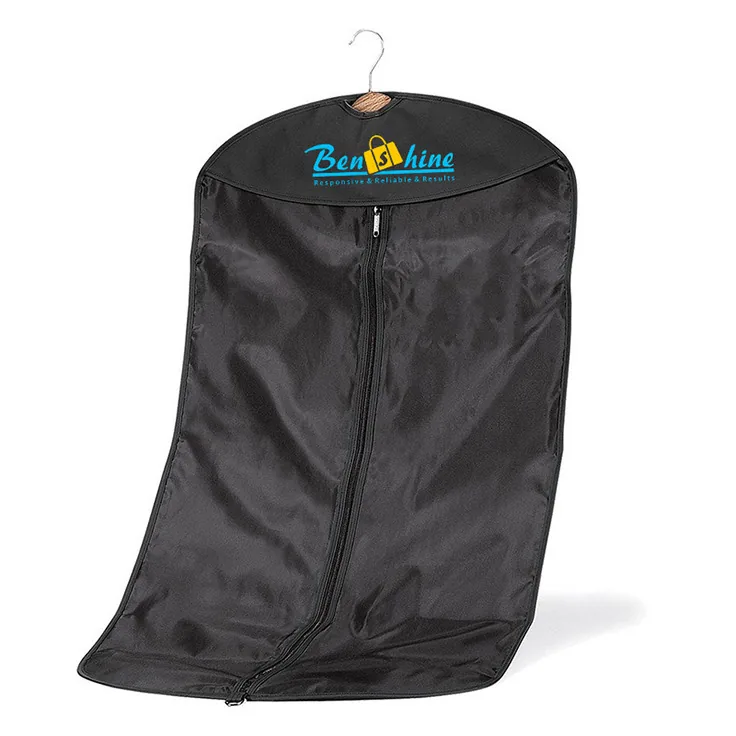
For source context, Benshine record GB01 identifies a 61 × 110 cm reference and GB04 identifies a 120 × 65 cm reference. These are individual source records, not universal garment-bag sizes. A new project must be sized to its own garments and hanger.
Choose flat or gusseted capacity deliberately
A flat cover may suit a single thin garment when compression and access remain acceptable. Multiple pieces, bulky uniforms, wide skirts or thick coats may require a side, bottom or full gusset. Gusset depth must be considered with the opening and hanger, not added as an isolated number.
Check the loaded cross-section at shoulders, body and hem. A uniform depth can be excessive in one zone and restrictive in another; shaped or tapered constructions may be considered where the workflow justifies the added pattern complexity. Test closure without forcing the garments against zipper teeth or seams.
The tote-bag gusset guide explains the difference between folds, panels and finished depth; the same measurement discipline is useful here even though the product geometry differs.
Design the hanger opening around the actual hook
The top opening can be a slot, bound hole, overlapping flap or another project-specific detail. Control its position, finished size, reinforcement and relationship to the zipper. Too small can obstruct the hook; too large can leave an unintended opening around it.
Review the hanger while the cover is loaded and vertical. Check whether the hook stays centered, whether garment weight pulls the opening, and whether the top panel rubs the garment or hanger. If the project uses several hanger types, identify the approved range or provide separate fit checks.
Do not describe a hanger slot as sealed or dustproof without defining the exposure and test. Any opening can affect the protected area.
Set access around packing and removal
Common directions include a full or partial front zipper, side opening, wraparound access or an open-bottom construction. The choice influences how staff load the garment, how much it must bend and whether the zipper can contact delicate fabric.
Define zipper start and stop positions, opening direction, clear opening length, puller access and end treatment. Check access with the garment hanging and with the cover lying flat if both workflows occur. Long zippers need alignment across curved or flexible panels; local distortion can create waves or difficult operation.
GB04 illustrates a full-length hanging-cover direction with a central zipper and shaped shoulder area. Exact material, fit and protection remain project-specific.
Use the bag zipper and hardware guide to specify chain, slider, puller, tape, end stops and installation as one system.
Select materials by workflow and contact
Possible directions include woven textiles, non-woven fabrics, canvas-like fabrics, clear or translucent films and laminated constructions. Each generic label covers multiple grades. Record exact composition, weight or thickness, construction, colour, finish, usable width and supplier reference as applicable.
A woven polyester shell, for example, still requires a denier or yarn direction where relevant, fabric weight, weave, coating or backing, colour and finish. “Non-woven” does not identify fibre, mass, bonding route or performance. “PVC window” should be confirmed as an exact film construction rather than inferred from transparent appearance.
If restricted substances, fibre labelling, recycled content, skin contact or another market requirement applies, connect the requested evidence to every relevant production material. A report for one shell fabric does not automatically cover the window, ink, zipper, binding, thread or reinforcement.
Opacity and visibility are separate design choices
An opaque cover can hide the garment, while a window or translucent panel can support identification. Define how much garment visibility is needed, at what location and under what viewing condition. A large window changes flexibility, folds, sewing and pack-out; a small identification pocket may satisfy a different workflow.
For a clear panel, approve exact film identity, thickness, colour or clarity, surface finish, flexibility and joining method. Review wrinkles, scratches, haze, blocking, edge stress and temperature-sensitive behaviour under project conditions where relevant. Do not promise that a film will remain clear or resist yellowing without a defined test and time condition.
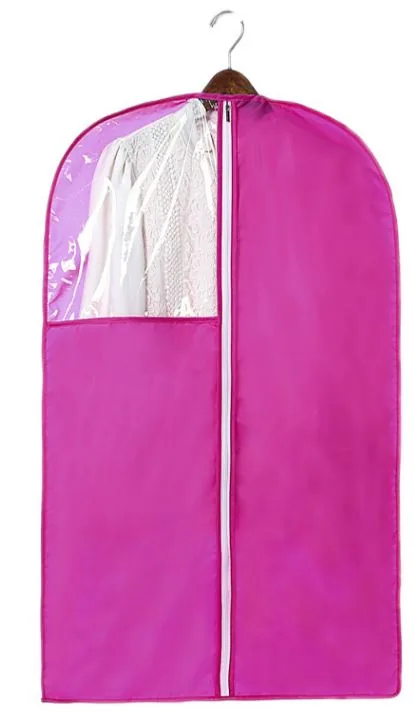
GB13 shows how a viewing panel, zipper and opaque lower section can support visual identification. The image does not establish film composition, long-term clarity or barrier performance.
Breathability is not a category-level guarantee
“Breathable garment bag” needs a measurable meaning. Air and moisture movement depend on the exact shell, coatings, films, seams, zipper, hanger opening and vents. A porous panel may allow air exchange but also changes dust and splash behaviour.
Start with the storage environment and garment condition. Define whether the product must release residual moisture, limit condensation, reduce dust entry or simply avoid a fully closed film enclosure. These goals can conflict. Select a material and construction, then validate the complete bag under the relevant conditions rather than assigning breathability to a fabric name.
Dust and moisture protection require defined exposure
A cover can physically separate a garment from surrounding contact, but the protection level depends on every opening and seam. “Dustproof,” “water-resistant” and “waterproof” are different claims. A zipper, hanger slot, window seam or open bottom may be a dominant path.
Define the contaminant or water exposure, duration, orientation, closure state, protected zone and acceptable result. If the garment is sensitive, use a clean surrogate during development. Do not use a generic category label as proof.
The water-resistant versus waterproof bag guide provides a framework for finished-product claims and repeatable protocols.
Control garment-contact surfaces and colour transfer
Shells, linings, bindings, prints, labels and windows can contact the garment during storage or folding. Identify light-coloured, delicate or coated garments that create a higher transfer or snagging risk. Review both the normal face and any reverse-side seams or decoration.
Where colour transfer matters, specify the exact contact materials and relevant dry, wet, heat or pressure condition. A dry rubbing result does not answer every storage scenario. Test production-intent colours, especially dark or saturated components, and define acceptance for the destination garment.
Keep rough edges, exposed fastener parts and unfinished zipper ends away from sensitive areas. Approve the inside as deliberately as the exterior.
Develop seams, binding and edges as a system
Seam type, allowance, binding, thread, needle, stitch spacing and tension interact with the shell, film and reinforcement. Mixed-material seams can feed or stretch differently. Clear film can show needle holes or stress; non-woven edges may need different control from woven textile.
Map the shoulder curve, zipper join, side seams, bottom, hanger opening, window, pockets and handle anchors. Define face and reverse appearance, skipped-stitch limits, start and end treatment and repair rules. The bag stitch-length guide helps translate “good stitching” into measurable criteria.
Foldable travel formats need a second use state
A travel garment carrier works in at least two states: open for garment loading or hanging, and folded for transport. Define fold lines, folded dimensions, closure points, handles, shoulder strap, pockets and hardware in both states.
The garment arrangement matters. Check whether the fold compresses structured shoulders, creates a hard pressure point or allows the hanger to shift. A bag that closes while empty may not close with the intended suit set and accessories.
Use representative packed mass to assess handle position, balance, body deformation and attachment load. If the design attaches to luggage, define the interface and test it with the intended luggage geometry. “Wrinkle-free” should not be claimed from format alone; garment construction, packing method, time and handling all influence the result.
Handles and straps need a complete load path
For hanging-only covers, a bottom loop or grip can help handling without converting the item into a travel carrier. Foldable designs may use handles, shoulder straps, rings, hooks or fastening tabs. Specify component material, width, length, hardware, routing and attachment reinforcement.
The panel around an anchor is part of the load path. A strong strap does not compensate for a small reinforcement or unsuitable panel material. Define a finished-product lift, static-load or cycle method when required, including packed contents, mass distribution, orientation, cycles or duration and pass criteria.
Pockets and identification should follow the workflow
Pockets can hold shoes, accessories, documents, labels or identification cards, but each addition affects balance, folding and garment contact. Define pocket contents, dimensions, closure, location and maximum intended load. Keep hard contents away from delicate garment zones where required.
An identification window may be external, removable or writable depending on the operation. Define card size, insertion direction, retention and whether personal information should be visible. Avoid placing a pocket across a fold line unless the loaded folding test confirms it works.
Place branding in every final presentation state
Logo visibility can change when the cover hangs, folds, ships in a carton or appears in retail. Provide artwork version, dimensions, colours, location and viewing orientation for each approved format. Mark zipper, window, seam and fold-line clearances on the artwork drawing.
Printing, heat transfer, embroidery, labels and patches have different compatibility with woven shells, non-wovens and films. Approve a strike-off on the exact production material and colour. Review opacity, edge definition, registration, hand and the project’s rubbing, folding or care exposure. The branding-method comparison supports process selection.
Cleaning, odour and storage conditions belong in the brief
State whether the cover is disposable, limited reuse or intended for repeated service. Define expected cleaning or wipe-down method and drying conditions. Materials, inks, adhesives, films, zippers and windows may respond differently, so approve the complete construction under the actual care direction.
If odour is important, define when it is assessed, after what airing or conditioning, by whom and against what acceptance reference. Avoid universal “odour-free” wording. Store and pack materials in a way that supports the agreed cleanliness and moisture condition.
Folding and packaging can change the product
Garment covers have large panels and are often folded for shipment. Define fold sequence, final pack dimensions, inserts, individual packaging, carton quantity and orientation. A window or coating can crease, block or mark under pressure; zipper pullers and hanger hooks can imprint nearby panels.
Conduct a pack-out trial using production-intent materials. After the defined storage or transit simulation, reopen the product and review appearance, zipper operation, window condition, dimensions and usability. Packaging evidence should match the actual carton and arrangement rather than a loose sample.
Approve garment bags in controlled stages
- Content brief: garment types, hanger, quantity, measurements and workflow.
- Material swatches: exact shell, window, lining, binding, reinforcement and evidence.
- Fit mock-up: usable dimensions, gusset, hanger opening and garment insertion.
- Construction sample: zipper, seams, window, pockets, handles and branding.
- Loaded-use review: hanging, folding, carrying, reopening and garment condition.
- Project tests: named fit, colour, load, water, care, window or packaging protocols.
- Pre-production sample: freeze pattern, bill of materials, workmanship, artwork and pack-out.
A substitution in shell, film, coating, zipper, binding, thread, reinforcement or packing can affect earlier approvals. Record change control and decide which tests must be repeated.
Production quality-control points
Order-specific inspection can include:
- shell, window, lining and reinforcement identity;
- material weight or thickness under the agreed method;
- colour, opacity, clarity, hand and surface condition;
- finished external and usable dimensions;
- hanger-opening size, position and reinforcement;
- gusset, shoulder curve and bottom geometry;
- zipper alignment, clear opening, puller and end function;
- seams, binding, edges, stitch spacing and skipped stitches;
- film scratches, haze, wrinkles or joining defects;
- pockets, labels and identification features;
- handles, straps, hardware and anchor reinforcement;
- artwork size, colour, position and fold-line clearance;
- representative-garment fit and closure;
- folded dimensions and packed presentation;
- project-specific functional tests and traceability;
- conformity to the approved sample and revision.
Sampling does not prove every unit. Connect incoming checks, first-piece approval, in-line controls and pre-shipment review using the custom bag quality-control guide.
Custom garment bag RFQ checklist
Send the manufacturer:
- garment type, dimensions, thickness and pieces per bag;
- garment photos or physical reference where available;
- hanger dimensions, hook details and supplied sample;
- storage, retail, uniform, service or travel workflow;
- finished external and usable internal dimensions;
- flat, gusseted, shaped or foldable format;
- hanger opening, zipper or access direction;
- exact shell, lining, window, binding and reinforcement;
- material composition, weight, thickness, colour and finish;
- pockets, identification, loops and accessory requirements;
- handles, strap, hardware, fold closure and attachment details;
- artwork files, branding process, size and placement;
- contact, dust, moisture, care and storage conditions;
- fit, colour, zipper, seam, load, water, care or packaging protocols;
- target-market labels and evidence scope;
- approved swatch, sample and change-control requirements;
- quantity by size, colour and version;
- folding, individual packaging, carton and delivery requirements.
MOQ, price, feasibility and timing depend on dimensions, material commitments, windows, zippers, pockets, carrying, branding, testing, quantity and packaging. Request current project confirmation after the specification is reviewed.
Develop around the garment, not a generic cover
Benshine can review hanging covers, suit bags, uniform covers and foldable travel directions around the actual garment, hanger, workflow, usable dimensions, materials, access, carrying, branding, tests and quality controls. Existing records provide visual construction references; each new project’s material, performance, evidence and commercial terms require confirmation.
Explore custom garment bags, review the GB01 hanging-cover reference, GB04 full-length reference and GB13 window-panel reference, or send your garment bag specification.
Quick answers
What measurements are needed for a custom garment bag?
Record the loaded garment length, maximum shoulder width, body and hem width, garment thickness, hanger dimensions, hook position and number of pieces per bag. Then define finished external dimensions, usable internal space, gusset depth, opening and closure around the actual garment set.
Should a garment bag be flat or gusseted?
A flat cover may suit a thin single garment, while layered, bulky or multiple garments may need controlled depth. There is no universal choice. Load the intended garments and hanger into a finished sample to confirm fit, closure, compression and hanging shape.
Which material is best for a garment bag?
No one material is best for every workflow. Woven textile, non-woven fabric, canvas-like fabric, film and laminated constructions have different identity, hand, opacity, surface, sewing and care considerations. Specify the exact material and validate the complete sample.
Does a garment bag protect clothes from moisture and dust?
The category name does not prove a barrier level. Protection depends on material, seams, hanger opening, zipper, window, pockets and closure. Define the dust or moisture exposure, protected area, duration and acceptable result, then test the complete closed bag.
What should be checked on a foldable travel garment bag?
Check garment arrangement, fold lines, folded dimensions, closure points, handles or strap attachments, hardware, pocket contents, carrying balance, reopening and garment condition. Use representative garments and packed mass in the approved test.
What belongs in a custom garment bag RFQ?
Include garment and hanger measurements, pieces per bag, workflow, dimensions, gusset, access, materials, window, carrying, pockets, branding, care, test methods, evidence requirements, quantity by version, folding, packaging and delivery requirements.